 John Myers
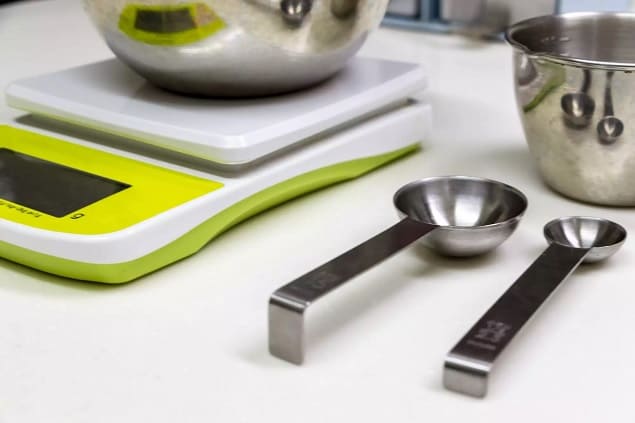
As with all units of measurement, there is a conversion formula for converting cups into grams or milliliters. As an approximation: 1 US cup corresponds to approximately 237 milliliters. Here we explain what you should consider when converting cups to grams.
Baking with a calculator? It’s much easier!
Anyone who has ever baked according to original recipes from the USA knows the American kitchen unit of measurement, the cup (US cup). The British Cup (Imperial Cup), on the other hand, is hardly used nowadays. Translated, cup means “cup”, which is very vague as a unit of measurement and does not really offer orientation.
There is no universal translation into grams (g) or milliliters (ml) for cup in practical use, because cup is a spatial measure for volume, the equivalent of which in the metric system of measurement varies depending on the object being measured. Butter and sugar have a higher density than flour or oatmeal, for example. 100 g of butter can be less than 100 g of flour in the cup equivalent. This may be a bit confusing at first, but with a conversion table from cups to grams you can easily translate the information in the recipes – a suitable measuring cup can also help!
How to convert cups to grams
So much for the theory. But what does that mean in practice? Here are some examples:
1 cup:
Flour: 130 g
Milk, water: 240 ml
Sugar: 220 g
Powdered sugar: 130 g
Butter: 225 g
Oils: 210 g
Rolled oats coarse: 115 g
Rolled oats fine: 120 g
Ground nuts and almonds: 130 g
Cocoa powder: 112 g
½ cup:
Flour: 65 g
Milk, water: 120 ml
Sugar: 110 g
Powdered sugar: 65 g
Butter: 113g
Oils: 105 g
Rolled oats coarse: 58 g
Rolled oats fine: 60 g
Ground nuts and almonds: 65 g
Cocoa powder: 56 g
Please note that the conversion table is for guidance only. When researching on the Internet or in baking books, you will find that the translation details can vary. In most cases, however, the differences are minimal, so the baking result should be similar or the same. Our recommendation: just try it out and adjust if necessary. This allows you to create a conversion chart suitable for your baking preferences. Place these with your baking books or hang them on the fridge – just look at the gram or milliliter figure and you’re good to go.
By the way: With our delicious baking recipes, you don’t have to do extra conversions! Try out our sophisticated recipes for banana quark pancakes with blueberry topping and our fluffy oatmeal pancakes. We can also warmly recommend our delicious chocolate cookies. We hope you enjoy baking – with or without a “cup”!

Facebook Comments