 John Myers
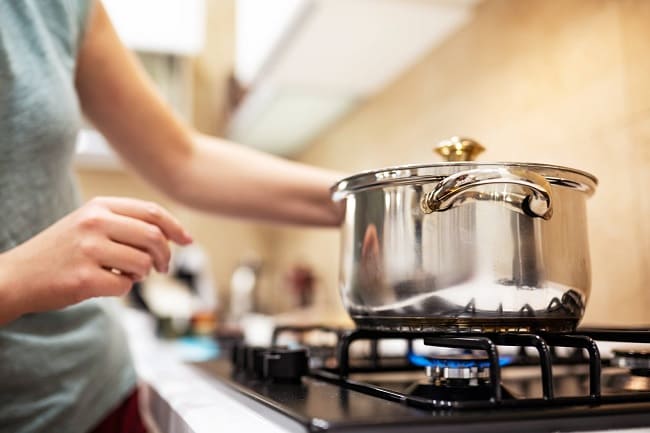
Not only professional chefs prefer the gas stove to an electric stove. Many amateur chefs are now cooking with gas because it has a number of advantages. These include the rapid heating, the clearly recognizable heat source and the inexpensive operation. However, cooking on the gas burner also has its disadvantages: pot handles heat up faster on the gas stove, food burns faster when kept warm and there is an increased risk of fire.
One of the most important advantages of the gas stove is that you can regulate the heat quickly and efficiently. Within seconds, a flame can be turned on to heat food. It can be turned down or switched off just as quickly. In this way, less energy is lost without being used. A gas stove also saves money in operation. A kilowatt hour of natural gas costs significantly less than an electric kilowatt hour.
On a gas range, pots and pans are placed on lattice-like structures over the gas burners, allowing for uneven-bottomed pots and traditional rounded-bottomed woks. Since the plates do not reheat, a pot can easily be left on the stove to cool after cooking. If you value keeping your food warm on the stovetop for a long time, you are better off with an electric stove.
The visible flame of a gas stove is also perceived by many as advantageous. Compared to an electric stove, it is less likely to accidentally touch a hot stovetop, which is often visually indistinguishable from a cold one.
One of the disadvantages of the gas stove is the heat that rises up the sides of the pots when the flame is high. It not only heats up pots and pans quickly, but also the handles. This makes handling more difficult, and plastic handles can also become deformed. Other serious disadvantages are the risk of fire and accidents posed by an open gas flame. Cooking on the gas stove should always be done with great care, so that potholders and sleeves do not accidentally get caught in the open flame. In addition, sufficient ventilation should always be provided so that escaping gas can escape unnoticed in an emergency. At the same time, mold formation due to the increased moisture formation during gas combustion can be prevented.



Facebook Comments