 John Myers
Ingredients for 1 servings:
- 9 g gelatin powder, white
- 6 tbsp water
- 20 g glucose
- 20 ml water
- 1,000 g powdered sugar
- 90 g palm fat
- Powdered sugar for working
- 1 ½ packets of pudding powder (vanilla flavor)
- 600 ml milk
- 3 tbsp sugar
- 250 g butter, room temperature
- 50 g sugar
- 1 ½ packets of pudding powder (vanilla flavor)
- 600 ml milk
- 3 tbsp sugar
- 250 g butter, room temperature
- 50 g sugar
- 100 g chocolate coating, whole milk
- 6 eggs (size L)
- 1 pinch of salt
- 180 g sugar
- 1 bag of vanilla sugar
- 100 g flour
- 80 g cornstarch
- 1 packet of pudding powder (vanilla flavor)
- 1 tsp baking powder
- 6 eggs (size L)
- 1 pinch of salt
- 180 g sugar
- 1 bag of vanilla sugar
- 100 g flour
- 80 g cornstarch
- 37 g cocoa powder
- 1 tsp baking powder
- 540 g jam (forest fruit), without seeds
- 200 g marzipan paste
- 50 g powdered sugar
- n. B. food coloring, possibly
Instructions
Working time approx. 6 hours; Rest period approx. 2 days; Cooking/baking time approx. 1 hour 10 minutes; Total time approx. 2 days 7 hours 10 minutes
great gift idea
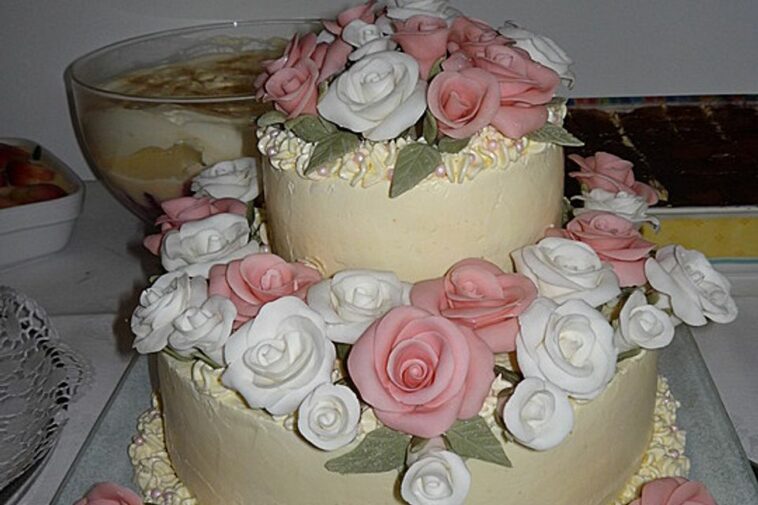
On the first day, make the fondant. To do this, mix the gelatin with 6 tablespoons of water and let it swell for about 10 minutes. Then heat until the gelatin has dissolved. Do not let it boil! Mix the glucose and 20 ml of water and heat again. Once the glucose has dissolved, mix the glucose mixture with the gelatin. Gradually stir 250 g of powdered sugar into the liquid. Melt the palm fat and also add it to the mixture. Gradually stir in the remaining powdered sugar, or later knead it in, until a firm dough forms. Add a little more powdered sugar or fat if desired. The finished mixture will later cover the cake. It can be colored with food coloring if desired, or left classic white. You can also model shapes (e.g. roses). This amount is sufficient for both cakes and some fondant flowers. To roll out the dough, generously sprinkle the work surface with powdered sugar. Store the finished fondant in an airtight container until ready to use to prevent it from drying out and hardening. This is best done at least a day in advance. On the second day, prepare the buttercreams and sponge cakes. For the light buttercream, mix 1.5 sachets of pudding powder with 100 ml of milk. Bring the remaining 500 ml of milk and 3 tablespoons of sugar to a boil. Then stir in the dissolved pudding powder and bring back to a boil. Let the pudding cool. Stir occasionally to prevent a skin from forming. Beat the butter and sugar until fluffy and white. When the butter and pudding are roughly the same temperature, mix the pudding and buttercream together. Proceed in the same way for the dark buttercream. However, here you also stir 100 g of chocolate coating into the hot pudding. The chocolate coating does not need to be melted beforehand; simply add it in pieces to the hot pudding. Both types are sufficient for filling and coating one 28 cm cake. For the light sponge cake, separate the eggs. Beat the egg whites with a pinch of salt until stiff. Gradually add the sugar and continue beating until the mixture is very stiff and glossy. Now gradually add the egg yolks, one at a time, while continuing to beat. Mix the flour, cornstarch, custard powder, and baking powder, then sift and carefully fold them into the egg mixture by hand. Bake the sponge cake in a 28 cm springform pan on a rack in a preheated oven at 180°C (top/bottom heat) for approx. 35 minutes – be sure to do the skewer test! Allow to cool. Prepare the dark sponge cake in the same way, but replace the custard powder with cocoa. If desired, one layer can now be cut to size so that the wedding cake can be stacked later. For example, you can cut a 4 cm thick edge off the light sponge cake to later place on top of the dark cake. Of course, the ingredients can also be reduced to a smaller springform pan size (if available). Once each sponge cake layer has completely cooled, cut it crosswise into three equal layers. Spread some of the buttercream on the bottom layer (dark buttercream on the dark layer, light buttercream on the light layer). Then add a thin layer of wild berry jam. Take the buttercream out of the fridge well in advance so it spreads evenly. Place the next layer on top and spread it first with buttercream and then with jam. Now add the third layer and cover the entire cake thinly with buttercream (including the sides). For the small cake, be sure to keep some buttercream left over. You will now have, for example, a dark (large) and a light (small) cake. These should be refrigerated until the next day. On the third day, assemble the cakes and decorate them. Knead the fondant until soft and roll out two thin circles. One large one for the cover of the large cake and one small one for the small cake. The buttercream on the outside of the cakes helps the fondant bond well to the cakes, making it easy to spread evenly. The spot where the small cake will be placed on top of the large one is covered with a thin layer of the buttercream left over from the day before to prevent the top cake from slipping. Now you can decorate the cake as desired with marzipan figures, fondant flowers, etc. The decorations can be beautifully attached to the fondant with icing. Then store the cake in a cool, dry place.

Facebook Comments