 John Myers
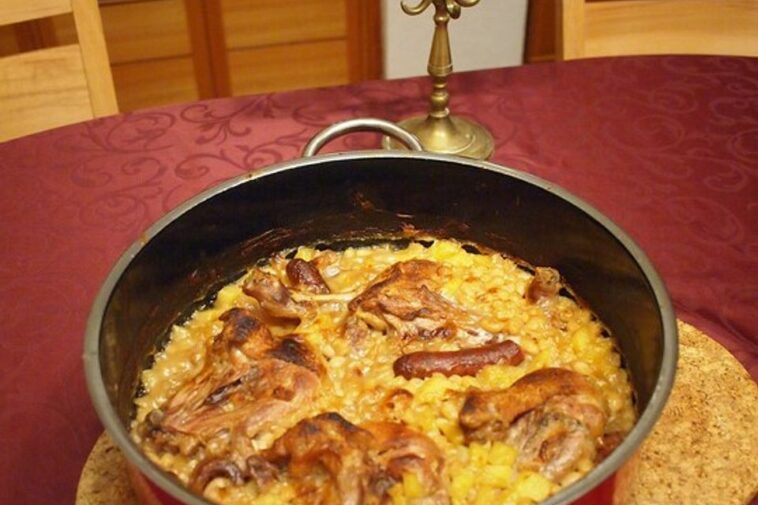
Ingredients for 4 servings:
- 1 poultry carcass(s), without legs or wings
- 4 pork bones from pork chops or pig’s feet
- 250 g pork rind
- 1 onion(s)
- 6 carnations
- 2 carrots
- 1 sprig(s) rosemary
- 2 sprigs of thyme
- 3 bay leaves
- 3 ½ liters of water
- 600 g beans, white (preferably lingot), dried
- 5 duck wings (duck confit wings or upper arms, pickled in their own fat)
- 2 duck legs (duck confit, preserved in its own fat), halved
- 320 g pork sausage with garlic (Toulouse sausages)
- 200 g pork from the shank, shoulder or breast
- 200 g bacon, salted (raw, not smoked)
- 7 garlic cloves
- e.g. salt and pepper
Instructions
Working time approx. 3 hours; Rest time approx. 1 day 1 minute; Cooking/baking time approx. 5 hours; Total time approx. 1 day 8 hours 1 minute
A challenge, but a door opener to the paradise of grandmother’s kitchen.
For the broth, fill a large pan with water, cut the rind into large pieces, add the poultry carcass, pork bones, onions studded with cloves, spices, and carrots. Season generously with salt and pepper. Simmer the broth for about 1 hour, then strain. Taste the broth; it should taste like a very rich soup. Set aside the rind pieces and discard the rest. Soak the dried beans in cold water for 24 hours. Discard the water the next day. Add the beans to a sufficient amount of cold water and boil for 5 minutes. Remove from the heat and drain the water. Now cook the beans in the broth above for about 60 minutes, until they have a firm bite but are not broken down. Drain the beans and keep the broth warm. Meanwhile, prepare the meat while the beans cook. To do this, in a large frying pan over low heat, remove the fat from the confit pieces and set aside. Brown the Toulouse sausages in the remaining fat, then cut into 60-80g pieces and set aside. Brown the pork pieces until golden brown and set aside with the other meat. Now thoroughly mix the garlic with the salted bacon cubes and fry lightly. Be careful not to burn the garlic. Now assemble the cassoulet. Line the bottom of a casserole dish or cast iron pan with all the pork rind pieces cooked for the broth and scatter about 1/3 of the beans over it. Spread the meat over the top and add the rest of the beans. Place the sausages on top, gently pushing them into the beans; they should remain just visible. Pour in the hot broth, which should just cover the beans. Generously grind the surface of the pepper and drizzle with some of the duck fat used to brown the meat. Place in a well-preheated oven at 150°C-170°C (top/bottom heat) and cook for two to three hours. Important: Always uncovered! During cooking, a golden-brown crust will form on top of the pan, which needs to be pressed down several times (old folks say seven times). If the surface of the beans begins to dry out, add a little broth. Cassoulet drinks a lot of water. If this cassoulet is prepared the day before—which only improves the flavor—it should be reheated in a preheated oven at 150°C (300°F) for another 1.5 to 2 hours before serving, until the surface bubbles. Add a little broth, or water if it’s all gone. Very important: Serve the cassoulet simmering in its bowl or pan. Carefully bring it to the table without stirring or ladling. It will only get better, and don’t hesitate to order more: this is a dish that will transport you to the paradise of popular gastronomy! A fresh baguette and a full-bodied red wine from Cahors (Château Lamartine), Madiran (Château Montus), or the Côtes-du-Frontonnais (Château Bellevue-la-Forêt) go well with this. Cassoulet is a one-pot bean dish. To prepare it, you need a large pan for the broth and a large ovenproof clay, earthenware, or ceramic bowl (originally called a cassolo, now a cassole; google it for a picture) that is wide at the top and narrows towards the bottom. If you have the right bowl and you have a bit of a feel for it, you can do the entire preparation (except for the broth) in this dish. It produces the best flavor. If you don’t have this bowl or don’t have enough experience with it (risk of breaking when searing), a solid cast iron frying pan will also do. I use an original Moroccan tagine for up to 4 people, with a cast iron frying pan on top. The aforementioned “Saucisse de Toulouse” is hard to find outside of France. As a substitute, I use regular, raw pork sausages and inject the garlic juice extracted from the juicer into several places using a disposable syringe. About 3-5 ml per sausage, then let it marinate overnight. This effort is worth it, as this sausage and the duck are actually the centerpiece of the dish. If you can’t find the canard confit locally, you can find my recipe here: https://www.chefkoch.de/rezepte/4015821617183686/Canard-Confit-eingelegte-Ente.html I first came to Castelnaudary to start a boating holiday on the Canal du Midi. Afterwards, my job also brought me to this area, and I was fortunate enough to experience authentic, traditional cassoulet. To preserve the art of preparing it, there is the Confrérie du Cassoulet de Castelnaudary. This brotherhood gave me three different recipes. All good, but somewhat chaotic in their execution. I cooked them many times, then translated and rearranged them in a more logical chronology.



Facebook Comments