 John Myers

Ingredients for 6 servings:
- 6 pieces of potatoes
- 1 m.-large celeriac
- 2 large tomatoes
- 1 cup sour cream (10%)
- 1 cup crème fraîche (30%)
- 1 roll, stale
- 1 serving of clear broth with vegetables
- 2 onions
- 9 carrots
- 1 stalk of lovage
- 1 stalk(s) leek
- 1 kg flour
- 1 liter of milk
- 1 cube of yeast
- Flour for the worktop
- Fat for the pan
- 150 ml water
- 1 tsp salt (heaped tsp)
- e.g. water, cold
Instructions
Working time approx. 2 hours; Rest time approx. 4 hours; Total time approx. 6 hours
Steamed dumplings Baden style with original Grandma Gertrud’s potato soup
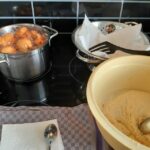
For Grandma Gertrud’s potato soup, peel the carrots and potatoes, cut them into thumb-sized pieces, and add them to a large (!) pot of cold water. Peel and dice the celeriac, then add it to the pot. Finely chop the lovage stalk (also known as Maggi herb in Baden). Add a portion of clear broth with the soup vegetables and a heaped teaspoon of salt to the pot. Wash and quarter the tomatoes, and add them as well. Bring the mixture to a boil for 5 minutes and then simmer over low heat for about 4-5 (!) hours, stirring occasionally. Once all the ingredients in the pot have softened, press the entire contents through a colander (a coarse sieve) to achieve a uniform consistency. You can also achieve this using a hand blender. However, the soup simply tastes better if it’s squeezed out rather than chopped. Now take the 2 onions, dice them very finely, and fry them in a little oil or margarine in a pan until golden brown. Set these aside. The potato soup is then refined with 1 cup of sour cream and finally rounded off with crème fraîche. Caution – season occasionally so that the flavor of the crème fraîche does not overpower the dish. After seasoning, add the onions and continue simmering on low heat until ready to serve. Season again as needed. The potato soup can be frozen without any problems and enjoyed weeks later. For the steamed dumplings, put 1 kg of flour in a large bowl and heat the milk until lukewarm (not too hot!). Put the yeast in a cup and add about 1.5 teaspoons of sugar to allow the yeast to rise. When this is the case: Mix the yeast, milk, and flour into a dough. Let it rise in a warm place (e.g. near a heater) for about 1 hour. Form small balls from the dough and place them on a floured board. Make sure the surface of the dough balls is relatively smooth. If necessary, simply smooth the balls so that any excess shriveled dough points downwards when the balls are placed on the board, thus flattening them out. Form the balls to about 7cm in diameter and let them stand for at least 30 minutes so that the yeast can loosen the dough a little. Heat a frying pan with oil, fat, or margarine and about 150ml of water and wait until the water in it boils. Place 3-4 dough dumplings in the boiling fat and water mixture and close the lid. Do not open the lid again! Once the water has evaporated and the steamed dumplings have risen, lift the front of the pan slightly. When the condensation drips off the pan lid and you hear a hissing sound, this is the sign that the lid can be removed. However, if the lid is removed too soon, the dumplings will collapse. Leave the dumplings in the pan with the lid off for a few more minutes so that the crust of the dumplings turns a light brown. During this time, lift the dumplings occasionally until the desired brownness is achieved. The dumplings are eaten after the soup has been consumed, or dipped in the soup in the Baden style and then eaten. Have fun making this recipe—it’s certainly a lot of work, but it’s truly worth it. Our family (children, grandchildren, and great-grandchildren of Grandma Gertrud) will drive hundreds of kilometers if necessary to make their famous dumplings with potato soup. After my successful first attempt today, I’ve decided not to withhold this wonderful recipe from you all…


Facebook Comments