 John Myers
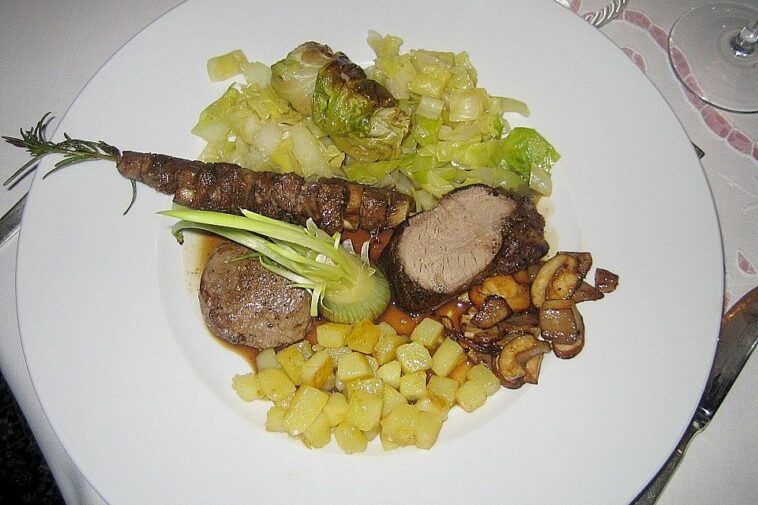
Ingredients for 4 servings:
- 1,200 g venison (roast venison leg)
- 150 g venison (fillet)
- 4 sprig(s) rosemary (approx. 15 cm long)
- 2 heads of pointed cabbage, small
- 4 garlic bulbs, fresh with stems
- 250 g mushrooms, brown
- 1 stalk(s) leek, the white part cut into rings
- 50 g celeriac, diced
- 1 carrot(s), diced
- 1 onion(s), finely chopped
- 3 cloves garlic, finely chopped
- ¼ liter wine, red, dry
- 400 ml Game stock
- 1 liter broth, concentrated
- 1 shallot(s)
- 1 tbsp liver sausage
- 1 tsp mustard, extra hot
- butter
- olive oil
- Pepper, from the mill
- Salt
- 3 liters of buttermilk
- Balsamic vinegar
- Jelly (blackcurrant jelly)
- Butter, in flakes
Instructions
Working time approx. 2 hours; Total time approx. 2 hours
I have planned three variations. 1. A slice of meat from the leg 2. A rosemary sprig as a shish kebab skewer (fillet) 3. A pointed cabbage roll (leg) Thaw the frozen meat in buttermilk; this makes the meat more tender. If I use fresh meat, this is of course not necessary, and also the milk is not on the list of ingredients. Strip the needles from the rosemary sprigs, but only enough to leave a tuft about 2 cm long on top. Save the needles. Rinse the meat under cold water and pat dry with kitchen paper. Trim the leg neatly all around, or if unnecessary, cut off a slice weighing about 150 g. This will be used later for the roulade filling. Season the leg meat with pepper and salt and sear it all over in hot oil in a roasting pan. Briefly sweat the leek, celery, carrot, onion, and garlic. Deglaze with the red wine and add the game stock and the stripped rosemary sprigs. Insert a meat thermometer into the center of the meat and place the uncovered pot in an oven preheated to 80°C. It will take about 4 hours until the internal temperature of 75°C is reached and the roast is done. Cut a 5 mm wide slice off the bottom of the fresh garlic bulbs, leaving the cloves exposed and allowing the bulbs to stand upright. Cook them in a small pan with a little oil over low heat for about 30-40 minutes. Cut the mushrooms into 1 cm cubes, as many as you need for the skewers, alternating with the meat. Slice the remaining mushrooms. Slightly sharpen the bottom of the rosemary sprigs. Cut the fillets into 1 cm cubes and place them on the sprigs, alternating with the diced mushrooms. Season the skewers with pepper and salt and fry in olive oil over medium heat for about 5 minutes. Then let it rest for a while. Peel four good outer leaves from the cabbage, blanch them briefly in boiling salted water and then refresh them in ice-cold water. Then dry them with kitchen paper. I prefer to use two small heads of cabbage rather than one large one, as otherwise the roulades will be too large. For the filling, finely chop the leg trimmings or slices, the shallot and a few mushroom slices with a chef’s knife. Add the liverwurst and mustard and mix. Stuff the cabbage leaves with this, roll them up and tie them with kitchen string. Brown the roulades in olive oil, pour in 1/4 liter of stock and simmer over low heat with the lid on for 20 minutes. Quarter the cabbage heads, cut out the stalk in the middle, then chop finely. Boil in the concentrated stock for 10 minutes, then drain. Keep warm. Fry the remaining mushroom slices in butter over medium heat for about 10 minutes. Remove the leg roast from the roasting pan and keep warm. Pour the stock through a fine sieve into a sauté pan and reduce over high heat. Season with mustard, balsamic vinegar, and blackcurrant jelly. Bind with ice-cold butter knobs. Place two tablespoons of cabbage on the plate, place the roulade on top, and add a slice of meat so that the rosemary skewer can be wedged vertically. Place the garlic bulb in front of the slice of meat, with the fried mushroom slices to the left and another side dish* to the right. Pour on the sauce. * As a side dish, serve with 1 cm cubes of boiled potatoes, tossed in foamed butter in a pan before serving. Spätzle also goes well with this dish. You don’t necessarily need game for this dish. I could also imagine using beef or lamb. Savoy cabbage is also a good alternative, but please avoid white cabbage; it doesn’t taste delicate enough.



Facebook Comments