 John Myers

Ingredients for 1 servings:
- 1 kg ham or other meat suitable for curing
- 50 g curing salt (nitrite curing salt)
- 50 g leek, 50 – 80 g, sliced
- 6 g glucose and cane sugar, half and half
- 5 juniper berries, crushed
- 3 carnations
- 1 garlic clove(s), or 2
- 20 g shallot(s), finely sliced
- 3 g black pepper
Instructions
Working time approx. 3 hours; Rest period approx. 26 days 10 hours; Total time approx. 26 days 13 hours
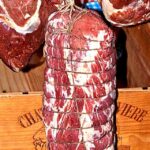
Ardennes ham is the classic dry-curing method used by local butchers in our area (when they still existed). It makes sense to have two curing vessels, as the meat is turned over every three days. Of course, one vessel also works, but then the cured meat must be stored for a short time. The pieces of meat are rubbed on all sides with the NPS-sugar mixture, with the pepper preferably rubbed onto the fiber ends. Then place the meat layer by layer in the curing vessel, leaving as little air space as possible, with leeks/garlic/juniper berries/cloves between the layers, and finally the remaining salt-sugar mixture on top. In the cellar at around 12-13°C, the brine forms within the first three days as the water is removed from the meat. Turn the meat over every three days; meat without rind (e.g., game) can be turned. Pork hams with rinds must be placed rind-down. The brine is, of course, poured back on. Ideally, the brine should be clear; if it’s very cloudy and smells sharp and sour, something isn’t quite “kosher.” After 12 days, the shallots, finely sliced and salted, are added. The total curing time is 21 days plus 2 days of “seasoning” (hanging to dry). After that, it must be soaked! In my experience, 10 hours of soaking results in a rather salty ham, 12 hours in a harmonious ham, and 14 hours in a fairly mild ham. Remove from the water, brush off any remaining residue, and dry. After 2-3 days of drying in the cellar, the ham is ready to smoke. Then, hang in a cool place for further aging/drying as usual. The first pieces can be tasted as soon as they are firm enough to slice. The drying time also depends on the thickness of the individual pieces; you’ll have to feel it! Smaller and/or smaller-diameter cuts can be cut into ready-to-use pieces and vacuum-packed after as little as 10 days. Thicker pieces of the hind leg should be hung for up to 6 weeks. Naturally, they will have a certain dryness to them, but the vacuum-packed ham homogenizes within a short time. In the cold part of the refrigerator and in an undamaged vacuum-packed package, no deterioration can be observed for up to 10 months.

Facebook Comments