 Micah Stanley
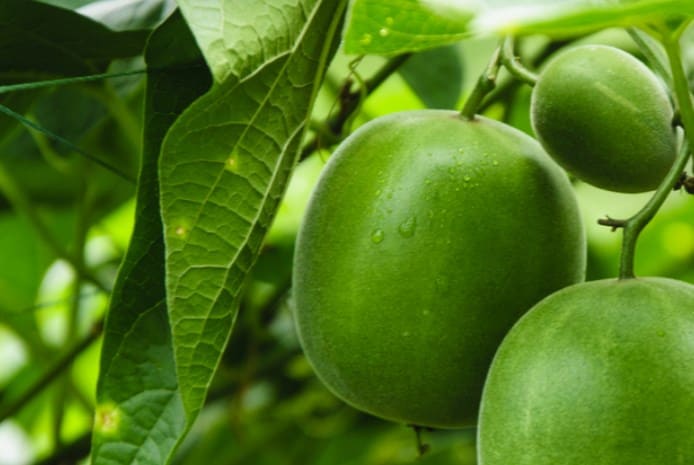
Luo Han Guo, a fruit from southern China, can serve as a natural sugar substitute. The natural sweeteners contained in the so-called monk fruit (monk fruit) are up to 500 times sweeter than sugar but have no harmful side effects. Luo Han Guo is also an ancient remedy for diabetes, colds, lung diseases, and gastrointestinal problems. Unfortunately, Luo Han Guo is not yet readily available in our region.
Luo Han Guo – The Monk Fruit
The climbing plant Luo Han Guo (Siraitia grosvenorii) belongs to the gourd family, like the pumpkin, cucumber, and watermelon. It is native to southern China and is rarely found in the wild.
In the mountains around Guilin – in southern China (in Guangxi) – Luo Han Guo has been cultivated for centuries because of the extraordinary fruits. These are 4.5 to 5.5 centimeters tall and round, have a bright green color, and are also called Luo Han Guo (pronounced Lo-hang-dscho). Today the area under cultivation is around 1,600 hectares. For comparison: sugar cane is grown on over 20 million hectares worldwide.
Luo Han Guo is also known as monk fruit because the Luohan Buddhist monks in the 13th century are said to have been the first to know about the special properties of the plant. The fruits taste incredibly sweet and also have healing properties.
The monks liked to use Luo Han Guo as a natural sweetener – primarily for teas and soups – but also used it to produce a wide variety of medicinal products. Then as now, e.g. B. heat stroke, indigestion, and colds to the most important areas of application.
Luo Han Guo: The secret is revealed
Until the 19th century, Luo Han Guo was known almost exclusively to the Zhuang – a Thai people in Guangxi – who guarded her secret like the apple of her eye. The fruits were sold on a small scale in local markets, but nobody except the Zhuang knew which plant the wondrous fruits actually came from. This is also the reason why Luo Han Guo was only included in traditional Chinese medicine (TCM) very late.
Outside of China, Luo Han Guo only gained attention in the 20th century. dr George Weidman Groff, professor of agriculture at Lingnan University in Guangzhou, visited the mountains around Guilin in 1932 and came across the secret plant. This was initially followed by a Luo Han Guo expedition, which was supported by the US National Geographic Society. A number of scientific studies were soon carried out. The first research results were then published in the course of the 1970s and 1980s.
With the increasing realization that there are many negative health consequences associated with the consumption of processed sugar – e.g. B. Fluctuations in blood sugar and insulin levels, obesity, dental caries, and chronic inflammatory diseases – the interest in the outstanding sweetening power of the Luo Han Guo fruit was further driven.
Luo Han Guo is now used and valued as a natural sweetener not only in China but also in many other countries. For example in New Zealand, Japan, Korea, Thailand, Singapore, and Australia. Everywhere there, the monk fruit is already considered a recognized sugar substitute.
Based on numerous studies, Luo Han Guo was finally classified as a GRAS product (=Generally Recognized As Safe) by the US Food and Drug Administration (FDA – Food and Drug Safety Authority) in 2009 – and thus classified as harmless to health.
Luo Han Guo and the Novel Food Regulation
In Europe, however, the situation is still unclear. Since Luo Han Guo was only known to connoisseurs for a long time, there was no discussion regarding approval. The interest on the part of the EU Commission was simply non-existent or imperceptible. In 2003, however, a court case took place in Munich, which is probably a precedent. A woman was sued by the Association of Social Competitions for promoting and selling remedies containing Luo Han Guo fruit extract.
It had to be clarified whether distribution fell within the scope of Regulation (EC) No. 258/97 of the European Parliament and Council on novel foods and food ingredients of January 27, 1997 – i.e. the so-called Novel Food Regulation and therefore requires approval.
The case went from the Munich Regional Court to the Munich Higher Regional Court and finally ended up in the Federal Court of Justice in 2007, where the accused was sentenced to a small fine for unfair competition. In addition, it was prohibited from continuing to offer the said products for sale.
Luo Han Guo was then classified as a novel food. These are foods and food additives that were not used for human consumption in significant quantities in any Member State before 15 May 1997 within the EU. Now, of course, the question arises as to how a fruit can be considered novel in Europe when it has been used for thousands of years, has already been approved in numerous countries, and has also been classified as safe by the FDA.
Is it perhaps because the mills in the EU simply grind a little more slowly and bureaucratic procedures unnecessarily prolong approval?
Luo Han Guo: A look into the future
A whopping 15 years have now passed since the court judgment just mentioned. However, consumers and manufacturers are still waiting for Luo Han Guo to finally be officially approved by the EU Commission. Initially, there was only the suggestion that the safe use of conventional foods from third countries over a longer period of time in the country of origin should be taken into account in the safety assessment and monitoring.
In 2019, the European Food Safety Authority (EFSA) finally reviewed the facts and came to the following devastating verdict: When it comes to monk fruit, the data is not yet sufficient to classify it as safe as a food additive. (20)
Nevertheless, Luo Han Guo is offered in numerous Asian shops and on the Internet and no legal measures are taken in this regard. How is that possible? As a rule, these are products that have been produced in countries such as the USA, where monk fruit has already been approved. If providers want to market a traditional food from a country outside the EU (third country) in the EU, the procedure is simpler: First and foremost, the applicant must prove that the food has been part of the usual diet of a certain number of people in the third country for at least 25 years people are.
Before the European food and beverage industry can use Luo Han Guo and develop its own products, however, the all-clear signal from EFSA is needed. A decision is expected by 2021.
Ultimately, it is up to the personal discretion of the consumer to decide now in favor of the healthy sugar substitute and buy foreign products or wait for the approval. In any case, we will inform you now about the versatile fruit and its health benefits.
Luo Han Guo: Sugar alternative and remedy
As you already know, Luo Han Guo is used as a sugar substitute and medicinal. However, a distinction must be made here. The fresh Luo Han Guo fruits are used extremely rarely in both respects. On the one hand, their shelf life leaves a lot to be desired, but on the other hand, they don’t taste particularly good either. That is why almost exclusively dried Luo Han Guo and extracts made from it – e.g. B. in powder form – is on the market.
The drying process is the best way to preserve the fruit and easily eliminate most of the unwanted aromas. A taste disadvantage, however, is that bitter substances form as a result of this process. From a medical point of view, of course, there are no losses, but as a sugar substitute, dried fruits are not to everyone’s taste.
The bitter substances are therefore removed with the help of special processes so that only now can a suitable sugar substitute and other tasty products are made from Luo Han Guo.
Why is Luo Han Guo so cute?
The Luo Han Guo fruit consists of 25 to 38 percent of various carbohydrates, including fructose and glucose. However, the mogrosides they contain are primarily responsible for the exceptional sweetness of the fruit. These are secondary plant substances from the group of saponins, the so-called triterpene glycosides.
There are five different mogrosides in the Luo Han Guo fruit. This mixture of mogrosides is about 300 times sweeter than cane sugar. The main components are Mogroside IV and especially Mogroside V, which in concentrated form can even be up to 500 times sweeter than sugar.
How sweet the various Luo Han Guo preparations taste depends entirely on the starting material and the concentration of the respective extract. For example, an 80 percent fruit extract is around 250 times sweeter than table sugar, while a juice extract tastes around 15 to 20 times sweeter.
In addition, mogrosides have healing properties and can help prevent various diseases.
Luo Han Guo against obesity
As already indicated, industrial sugar is anything but healthy. You can find detailed information, e.g. B. under Sugar – Effects on the body. Nevertheless, very few people want to do without the seductively sweet taste. Sugar alternatives such as Luo Han Guo, therefore, have great potential to counteract the global “obesity epidemic”.
The Luo Han Guo fruit offers the great advantage that the sweet mogrosides have no calories at all and also do not trigger cravings. Sugar, on the other hand, is one of the quickly digestible carbohydrates that only fill you up for a short time and constantly increase the feeling of hunger. This promotes the development of obesity.
Luo Han Guo for diabetics
It may seem contradictory that fruit as sweet as Luo Han Guo should help with diabetes, but the research results speak for themselves. For example, a Chinese study showed how differently a Luo Han Guo fruit extract and sugar affect blood sugar levels.
5 healthy men and women between the ages of 19 and 25 were given 200 milligrams of fruit extract dissolved in water per kilogram of body weight after overnight fasting. The blood sugar level was then measured after 0, 15, 30, 60, 120, and 180 minutes.
Three days later, the same subjects were given 3,000 mg of sugar dissolved in water per kilogram of body weight. Blood glucose values were determined at the same intervals. Here, the blood sugar level rose by a full 70 percent during the first 15 minutes, which of course is no surprise for sugar. In contrast, taking Luo Han Guo extract had no effect on blood sugar levels at all!
In addition, laboratory studies have repeatedly shown that Luo Han Guo extracts can even lower insulin resistance and reduce blood sugar levels. According to a study at Guizhou University in China, mogroside V, which lowers and stabilizes blood sugar levels by stimulating insulin secretion in the beta pancreas cells, is primarily responsible for this.
Incidentally, Luo Han Guo has long been used successfully in Chinese folk medicine to prevent and treat diabetes.
Luo Han Guo: Antioxidants protect against atherosclerosis and cancer
In China, Luo Han Guo is considered the fruit of immortality. This can be attributed to the fact that in the area where the plant is native, very many people live for over 100 years. The antioxidant mogrosides – in particular mogroside IV and mogroside V – are sometimes held responsible for this, which are known to be contained in Luo Han Guo.
A laboratory study conducted in 1996 at the Yamagata University School of Medicine in Japan showed that Luo Han Guo fruit extract keeps free radicals in check and counteracts the oxidation of blood lipids, which e.g. B. can lead to arteriosclerosis and thus to cardiovascular diseases.
In addition, Luo Han Guo fruits contain a lot of vitamin C – and vitamin C is known to be a very valuable antioxidant that also has a positive effect on blood vessel health. Studies have shown that 100 grams of fresh fruit can contain up to around 460 mg of vitamin C, which far exceeds the recommended intake of 100 milligrams per day for a healthy adult by the German Society for Nutrition. Although drying reduces the vitamin C content, even a single dried Luo Han Guo still contains as much vitamin C as a fresh orange, around 150 milligrams.
The antioxidants of the Luo Han Guo fruit also strengthen the immune system, counteract the aging process and can prevent the development of a number of chronic diseases such as e.g. B. the already mentioned cardiovascular diseases, but also prevent cancer. Various studies have also shown that Luo Han Guo extracts even have an inhibiting effect on the activation of the Epstein-Barr virus (EBV), which is carried by around 90 percent of the world’s population and is very protracted when it breaks out (glandular fever). and is difficult to treat.
Luo Han Guo in folk medicine
In Chinese folk medicine, the fruits, but also the leaves and seeds of the Luo Han Guo are considered long-established remedies that have never lost their attractiveness. Some of the areas of application include:
- diabetes
- heatstroke
- Gastrointestinal problems: e.g. B. gastritis and constipation
- asthma
- Cough or congestion caused by allergies or other respiratory problems
- laryngitis
- Sore throat
Luo Han Guo is so beneficial to the respiratory tract because it moisturizes and nourishes the mucous membranes and has expectorant effects. In addition, the antioxidants contained in the fruit have a positive effect on cleaning the blood and keeping the immune system on its toes.
In the heat, Luo Han Guo has a cooling and hydrating (moisturizing) effect. Especially on hot summer days, Luo Han Guo is ideal for sweetening smoothies, ice teas, or lemonades, as it cools the body pleasantly. In addition, Luo Han Guo is said to help with dry and chapped skin. Applied internally, for example in the form of tea, the complexion can be improved more sustainably than with expensive and chemical-laden anti-aging creams, according to the experience of users.
How is Luo Han Guo used?
As is common with home remedies, the Luo Han Guo recipes were passed down orally and passed from generation to generation. Since Luo Han Guo has only recently appeared in the western world, practical application tips are very rare.
The following recipes are taken from the book “Fruit As Medicine” by Dai Yin Fang and Liu Cheng Jun. The English translation came out in 1986.
- Heat stroke with thirst: Break open a dried Luo Han Guo fruit and pour boiling water over it.
- Acute or chronic laryngitis: Take half of a luo han guo fruit and 3 to 5 sterculia seeds. Cover the ingredients with water, let it simmer and swallow the tea very slowly.
- Chronic cough: Cover a piece of fruit with water, let it simmer, and drink the liquid twice a day.
- Constipation: Peel two fruits, cut them into pieces, and cover them with water. Let the tea simmer and drink it before bed.
Tip: According to another source, to prepare the tea, one Luo Han Guo fruit (20 grams) is boiled in 1 liter of water over low heat for 30 minutes. The following video shows you in detail how the tea can be prepared.
Luo Han Guo: What to consider when shopping?
The Luo Han Guo is one of the rare fruits because cultivation outside of its home region is considered difficult or impossible. This is because the plants depend on the unique climate that prevails there. Since the fruit is also very susceptible to rot, only the dried version is sold in European Asian shops.
In contrast to the fresh Luo Han Guo, the dried fruits are brownish in color. They are a bit reminiscent of kiwis and are very fragile, which is why they are usually sold in plastic packaging. In addition, a wide variety of Luo Han Guo products are offered in Asia shops, including teas, powders, liquids, and tabs.
Of course, you can also find Luo Han Guo products on the Internet – especially as powders or extracts for sweetening. Please use your search engine to find suitable products.
Luo Han Guo in the kitchen
As you already know, dried fruits and teas are intended more for healing purposes, while Luo Han Guo powder and Co. are ideal as a sugar substitute, for example, to bake cakes and cookies and to sweeten drinks.
The sweetening power depends primarily on the mogroside content. Does a product contain e.g. B. 80 to 90 percent mogrosides, it is about 250 times sweeter than sugar and compared to commercial sweeteners? In this case, when converting from sugar to Luo Han Guo powder, simply divide the amount of sugar by approx. 250.
When using Luo Han Guo extracts, be sure to consider that even if a product “only” tastes 80 times sweeter than sugar, it obviously cannot be used 1:1 like sugar. When it comes to sweetening, read the packaging instructions before use!
If you want to enjoy the full Luo Han Guo flavor, not just its isolated sweeteners, then you should use the whole dried fruit – for example in the preparation of a smoothie, chutney, soup, or vegetable stew. Simply add one Luo Han Guo for every 500 grams of the other ingredients.


Facebook Comments