 John Myers
Ingredients for 1 servings:
- 200 g poppy seeds, ground
- 200 g nuts, ground and roasted
- 200 g breadcrumbs
- 160 g sugar
- 400 ml milk
- 250 g quark
- 80 g sugar
- 1 egg yolk
- ½ sachet of vanilla pudding powder for cooking
- 1 pinch(s) of vanilla sugar
- 1,000 g spelt flour or white flour
- 120 g butter or margarine
- 120 g sugar
- 40 g yeast
- 15 g salt
- 500 ml milk
- 2 eggs
- 1 egg(s) for brushing
- Sugar granules
Instructions
Working time approx. 1 hour; Rest time approx. 1 hour; Cooking/baking time approx. 40 minutes; Total time approx. 2 hours 40 minutes
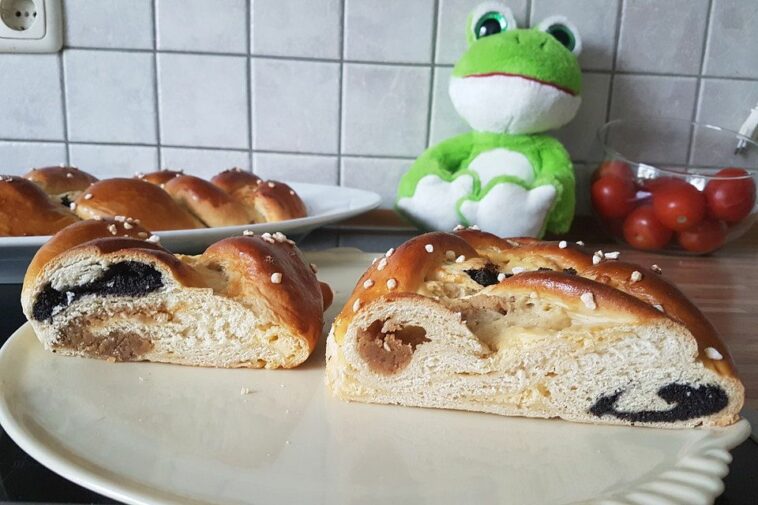
Yeast plait with nut, poppy seed and quark filling
I make the crumbs from hard sweet pastries, such as dry nut croissants or yeast dough. I simply grind or grate them like normal breadcrumbs. I always start with the three fillings so they have enough time to swell or warm up. Mix the poppy seeds with 100g of crumbs and 80g of sugar and stir into a firm paste with 200ml of very hot milk. Do the same for the nut filling: mix the nuts, 100g of crumbs, 80g of sugar and 200ml of hot milk. It can be a little softer, as the crumbs will still set a little. If the filling becomes too hard, add a little warm milk; if it’s too soft, add a few more crumbs. Simply whisk the quark with the sugar, egg yolks, custard powder and vanilla sugar. Please ensure that all three fillings are at the same temperature when using them! If, for example, the quark is too cold, the yeast dough around it will not rise properly! Put the flour in the bowl of the kneading machine, make a well in the middle and mix with the yeast, a pinch of sugar or, if available, some malt, and a little lukewarm milk to form a thick slurry. Cover this slurry with a little flour from the edge of the bowl and let it rest at room temperature for about 15-20 minutes until it starts to bubble. In the meantime, weigh the remaining ingredients onto the edge of the bowl onto the flour. When the slurry starts to bubble, pour about 5/6 of the warm, but not too hot, milk into the kneading bowl and mix in the machine on a low speed until you have a soft dough. If the mixture is still too stiff, add more milk. Then knead this dough with the machine – in my case a Kenwood on speed 4-5 – for about 5-6 minutes until you have a smooth dough. Make sure that the dough is really kneaded and not just going around in circles on your arm. In this case, I continually loosen the dough with a wooden spoon while kneading. Knead the finished dough briefly by hand again and place it back in the mixing bowl. Place the bowl in a warm place, e.g. in the oven with the light on, and let it double in size for about 30-40 minutes. Knead out the air by hand and leave it warm for another 20 minutes. Preheat the oven to about 170°C. Weigh out 6 pieces of dough, each weighing about 200g. If there is any leftover dough, I use it to make small braided loaves or something similar. Shape the 6 pieces into rounds and set aside for a few minutes to rest. Then flatten them and roll them out with a rolling pin so that they are slightly longer than the dish in which they will be baked. Divide half of the filling between each piece and spread it evenly with a dough scraper. Then roll up and braid each piece into a 3-strand braid. These braids can then be baked simply on a baking tray lined with baking paper or in a loaf pan. My pans are approximately 30 x 10 x 10 cm for the specified amount. Leave the dough pieces to prove in a warm place for about 30-40 minutes. When they are about 1/2 risen, carefully brush them with egg and sprinkle with sugar. When they are 3/4 risen, bake at 170°C for about 40 minutes until golden brown. If making smaller yeast pastries, shorten the baking time accordingly. The yeast dough can also be made without steaming, but then the yeast dough flavor will be less pronounced. The amount of yeast and the milk temperature influence the dough temperature and determine the fermentation time. Warmer and more yeast speed up the process.

Facebook Comments