 Bella Adams
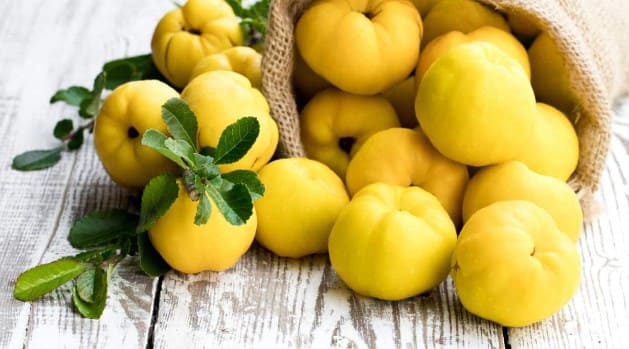
Quince is a fruit known for its fragrant aroma and tart flavor. In ancient times, quince was not only valued for its health benefits but was also considered a symbol of fertility and love. According to legend, King Paris presented this “golden apple” to the goddess Aphrodite, choosing her as the most beautiful of the goddesses. However, in Ukraine, this fruit is still considered quite exotic, and not everyone knows about its beneficial properties and wide application. That’s what we’re going to talk about.
Quince composition
Quince fruits are rich in various nutrients, namely:
- glucose;
- fructose;
- pectin compounds;
- essential oils;
- iron (more than in apples and pears), potassium, copper, calcium, and phosphorus;
- organic acids: malic, citric, tartaric, tartaric, tartaric;
- titanium;
- boron;
- amygdalin glycoside, tannins, mucilage, starch (contained in seeds);
- provitamin A, vitamins B1, B2, B6, B, C, PP, E.
The caloric content of quince is 40-60 kcal per 100 grams.
Types of quince
The scientific classification of quince has often changed due to the development of botany, as this fruit was known to people in ancient times. For a long time, it was attributed to the genus Pear, like apple and mountain ash.
Later, it was separated into a separate genus, Japanese Pear, which included three species: common quince, Japanese quince, and Chinese quince. However, due to the fact that there were many significant differences between these three varieties of quince, all three species were considered separate genera as early as 1822.
The common quince is a tree or shrub from 1.5 to 6 meters high. Its fruit is considered a false apple of lemon color, less often – dark yellow, with a tart taste. Quince fruits ripen in September-October. It is well suited for preservation, especially for making jam and marmalade.
Japanese quince is a shrub that reaches no more than 3 meters in height. The fruits are almost spherical, which are yellow apples with brown seeds. They can also be eaten, but they are harder than the fruits of the common quince.
Chinese quince is the record holder among the “sisters”: trees of this quince genus reach 10-18 m in height. Their crown is dense, the trunk is often curved.
Useful properties of quince
Quince has a positive effect on the body in case of diarrhea and gastrointestinal diseases. Traditional healers have long established that the use of quince fruits and decoction from them has a very good effect on the activity of the digestive tract.
For liver diseases, it is useful to eat boiled quince fruits. The same remedy will also help with vomiting.
To improve your appetite, you can take a decoction of dried quince fruits.
Eating fresh fruits and drinking juice is useful for anemia, and diseases of the cardiovascular system. It is also a good diuretic.
Quince syrup is used to treat anemia. To do this, the crushed fruits are boiled, squeezed, and boiled to the consistency of syrup.
The antiseptic effect of quince fruit will be useful for skin diseases.
For the prevention of iron deficiency anemia, as well as during recovery from an illness, it is very useful to eat fresh fruits. They contain a large amount of iron.
Quince is very useful for women. To stop or reduce uterine bleeding, people have long used a decoction of its fruits.
Quince seeds can be used to make an excellent expectorant for upper respiratory tract infections.
Quince is extremely useful for men. It is used to treat hemorrhoids.
Dried quince seeds are an excellent remedy for menopause.
An infusion of quince leaves can be used to relieve bronchial asthma attacks – it can relieve attacks or even stop them.
The high concentration of potassium in quince fruits is the reason to use them for hypertension.
People with eye diseases will also benefit from quince, namely a decoction of its fruit.
Quince helps to lower cholesterol levels.
The benefits of quince leaves and seeds
Quince leaves are also known to be beneficial in the treatment of bronchial asthma. An infusion obtained by boiling 6 quince leaves in 200 ml of boiling water for 15 minutes in a water bath can reduce or even stop the attacks of this disease. The leaves are squeezed out and added to 200 ml of water again. The infusion prepared in this way is taken 3 times a day, 2 tablespoons before meals.
The benefit of quince broth is that it is very good for uterine bleeding and poor appetite. You can prepare such a decoction by pouring 100 ml of boiling water over 10 grams of dried quince fruit. And take a decoction of the fruit before meals, 1 tablespoon.
The benefit of a decoction of quince seeds is that it is effective in the form of rinses in the treatment of sore throat, and in the form of lotions in the treatment of eye diseases.
Quince in cosmetology
Fresh quince juice is used to improve complexion, remove freckles and care for oily skin.
Quince-based lotions and balms tighten pores and make the skin softer.
Decoctions of quince leave color gray hair, making it darker, while strengthening and restoring it.
A decoction of the seeds of this fruit, rubbed daily for seven days into the scalp, relieves dandruff and normalizes the sebaceous glands.
Contraindications for eating quince
Eating quince can be harmful to the body if you have gallstones larger than 0.5 cm. This is due to the fact that the fruits have a choleretic effect, which can provoke the movement of stones through the bile ducts and their sticking.
Eating quince during pregnancy can also be harmful, as it can cause bloating and colitis, as well as aggravate the symptoms of toxicity.
Both the benefits and harms of quince depend on the rules for its use. For example, in the case of enterocolitis, the seeds and flesh of the fruit can provoke spasms and even intestinal blockage. For those who suffer from pleurisy and frequent constipation, the introduction of this product into the diet can also be harmful.
In addition, when preparing a decoction from quince seeds, they should not be crushed, as they contain the so-called amygdalin glycoside, which is poisonous and can therefore harm the body.
Selection and storage rules for quinces
In order to maximize the benefits of eating quince, you need to choose and store this fruit properly:
- when buying, you should choose large and dense fruits;
- it is necessary that the quince peel is evenly colored in yellow;
- green spots on the fruit should be absent, if they are, it is a sign of unripe and low-quality fruit;
- it is not recommended to choose fruits with dents – they will quickly deteriorate;
- quince is sensitive to shock, and therefore, when buying, you need to put it in a separate bag or package;
- The purchased fruit must be washed;
- store this fruit by wrapping it in polyethylene;
- In the refrigerator, the shelf life can be about 60 days;
it is not recommended to put a pear next to the quince, because in this case the quince will ripen very quickly and may spoil.
Quince is often called a “false apple” because its taste really resembles a cross between a pear and an apple. However, quince has few analogs in terms of its healing qualities and mineral and vitamin composition. It is one of the healthiest fruits and will definitely be indispensable in the cold season in case of winter vitamin deficiency. We hope that this information will be useful to you. Stay healthy!


Facebook Comments