 John Myers
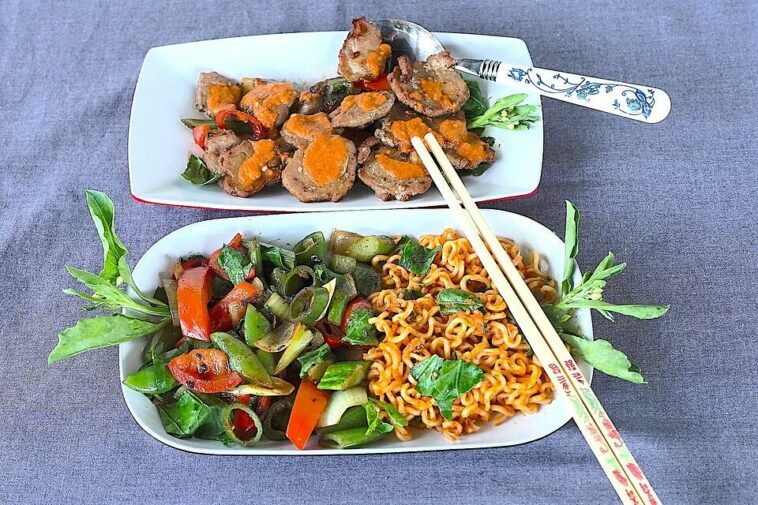
Ingredients for 2 servings:
- 250 g pork schnitzel
- 3 tbsp sauce (bulgogi sauce)
- 2 tbsp sauce (Saus Teriyaki Bawang, see note)
- 12 g papaya pulp, pureed, frozen
- 1 tsp baking powder
- 10 g spice lily (aromatic ginger)
- 1 piece(s) ginger, approx. 6 g
- 4 medium-sized garlic cloves
- ½ m.-sized vegetable onion(s)
- 1 small spring onion(s)
- ½ m.-sized bell pepper(s), green
- ½ m.-sized bell pepper(s), red
- 2 m.-large Pepper, green
- 1 Pepper, red, long, mild
- 12 snow peas
- 4 m.-tall Kailan (Chinese broccoli), white-flowering
- 200 g tomato juice
- 50 g tomato paste
- 1 tbsp sauce (bulgogi sauce)
- 160 g water
- 6 g vegetable stock powder
- 120 g Chinese egg noodles, wavy and dried
- Marinade, the rest of it (see above)
- 2 tbsp sauce (bulgogi sauce)
- 2 tbsp bean paste, black
- 2 tbsp tomato ketchup
- 50 g cooking water (from the pasta)
- 4 tbsp white wine, mild, golden yellow
- 1 tsp tapioca flour
- 2 tbsp rice wine, dark, spicy-mild
- 2 tbsp, leveled sauce (saus pedas ala Korea, see note), alternatively sambal oelek
- 4 tbsp coconut milk, 24% fat
- 1 tbsp rice wine, dark, spicy-mild
- 4 flowers from Kailan
- 4 tbsp sunflower oil
- 2 tbsp sesame oil, light
Instructions
Working time approx. 1 hour; Cooking/baking time approx. 15 minutes; Total time approx. 1 hour 15 minutes
A festive main course of a thousand delicacies. Recipe from Hong Kong, China.
Pound the pork cutlets slightly and cut into pieces about 4 cm in size. Mix the remaining meat ingredients into the marinade and marinate the meat in it for 1 hour at room temperature, stirring occasionally. In the meantime, for the vegetables, peel and wash the lily of the valley and ginger, then slice thinly across the grain. Quarter larger slices. Trim both ends of the garlic cloves, peel them, and slice thinly across the grain. Halve the onion lengthwise. Trim both ends of one half and cut lengthwise into strips about 1 cm wide. Wash the remaining vegetables. Cut the green part of the spring onion crosswise into rings about 6 mm wide. Cut the white part diagonally into pieces about 8 mm thick. Keep the green and white parts separate. Halve the bell peppers lengthwise, remove the stems from each half, remove the seeds, and cut lengthwise into strips about 8 mm wide. Chop these diagonally into pieces about 3 cm long. Remove the stems from the hot peppers, cut them crosswise into approximately 6 mm wide pieces, and remove the seeds. Cut off both ends of the snow peas, pulling off any long strings, if present. Cut off the flowers of the kailan, including the stems, with approximately 6 cm of the stem remaining, and use them for garnishing. Separate the leaves at the stem and chop the long leaf stalks into approximately 3 cm long pieces. Remove the midribs from the leaves, roughly chop them, and set aside with the green parts of the spring onion. Cut off the bottom of the stems, peel them, and cut them crosswise into approximately 2 cm long pieces. For the noodles, mix the tomato juice, tomato paste, bulgogi sauce, and water, and bring to a boil. Dissolve the vegetable stock powder in the broth and cook the egg-wheat noodles in the broth for 2 minutes until al dente. Strain the broth, leaving the noodles in the pot. Strain the meat pieces and drain well. Mix all the ingredients for the sauce in a pot, bring to a boil briefly, and keep warm. To garnish the meat, mix the saus pedas ala Korea with the coconut milk and rice wine. Drizzle the noodles with some of the leftover noodle broth and heat gently. Heat 2 tablespoons of the sunflower oil and 1 tablespoon of sesame oil in a wok until very hot. Add the meat pieces and stir-fry for 90 seconds. Remove with a slotted spoon and keep warm. Add the remaining oil and heat until very hot. Add the lily of the valley, ginger, garlic cloves, and sweet onion and stir-fry for 40 seconds. Add the white parts of the spring onion, bell peppers, chili peppers, snow peas, and the firm parts of the kailan and stir-fry for 3 minutes. Deglaze with the sauce and stir in the green leaves. Reduce the heat to low and simmer for 2 minutes. Divide the vegetables and noodles among the serving bowls and garnish with kailan flowers. Divide the meat pieces between two additional, preheated serving bowls, garnish with the coconut milk mixture, serve, and enjoy. Notes: If a dish contains more than eight delicacies, it is known in China as a dish of a thousand delicacies. Teriyaki Bawang sauce is a mild teriyaki sauce with a slight flavor of onions and garlic. It is made by the same manufacturer as Korean hot sauce, a dark red, spicy-hot sauce from Japan that is sold worldwide by a reputable manufacturer. The raw, fresh flower parts of the Kailan are among the special delicacies.


Facebook Comments