 John Myers
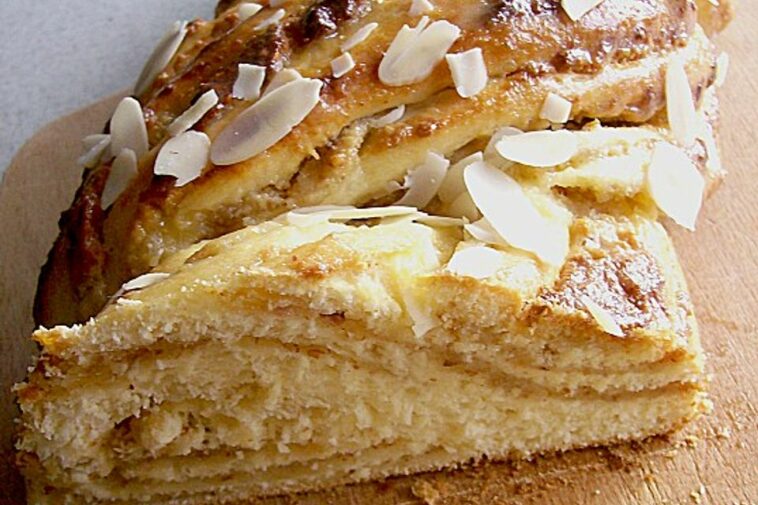
Ingredients for 1 servings:
- 250 g poppy seeds
- 150 ml milk
- 80 g sugar
- 50 g butter
- 1 kg flour, 405
- 500 ml milk
- 100 g sugar
- 150 g butter
- 42 g yeast, fresh (dry yeast also works)
- 3 eggs
- 2 tsp salt
- ½ tsp bitter almond flavoring or marzipan flavoring or
- 1 tbsp lemon peel
- 1 egg(s)
- 1 pinch of salt
- 1 tbsp sugar
- Granulated sugar for sprinkling, possibly also almond flakes
Instructions
Working time approx. 40 minutes; Rest time approx. 2 hours; Total time approx. 2 hours 40 minutes
This recipe works with or without poppy seeds. Without poppy seeds, simply omit the filling ingredients. Preheat the oven slightly (approx. 30°C) to allow the dough to rise later (see last picture). These instructions are for one large plaited loaf (1 kg flour). However, you can halve the quantities if you, as the only eater, don’t want to eat your yeast plaited loaf for days (picture 0). Warm the milk slightly. But only very slightly, as the yeast should later feel really comfortable and do its job diligently, making the dough rise beautifully. Now add your yeast (you can also use the yeast from a packet) and its most important partner, the sugar, to the lukewarm milk. Also add two eggs, lemon zest, or bitter almond oil (whichever the master baker prefers). Stir gently until everything is dissolved. In the meantime, sift flour into a sufficiently large bowl, as the dough will rise considerably and therefore need plenty of space if you let it rise long enough. Now pour the yeast milk into your flour and add softened butter and salt. You could, of course, add raisins or other treats like dried fruit or nuts of any kind. However, keep in mind that ingredients that are too moist will also reduce the dough’s shelf life. Now it’s time to roll up your sleeves and knead, unless you own a high-tech food processor. Knead with a hand mixer for five to ten minutes (Image 2). Work the dough until it is nice and smooth and supple. Cover the bowl with a (slightly) damp towel (Image 3) and place it in the oven. Let it rise for 1-1.5 hours (the longer the better). But be careful, the dough will more than double in size and should rest in a correspondingly large container (Image 4). This is where poppy seed plaited loaves diverge from pure plaited loaves: those who want to make a poppy seed filling shouldn’t sit back, but must get to work preparing it while the yeast dough is resting: Boil 150 ml of milk, melt the butter in it, and remove the milk from the heat. Then add the sugar and gradually the ground poppy seeds (image 5). The result should be a smooth, compact mass that can stick to the spoon when you turn it over (i.e., not be too runny). Set everything aside and wait until the dough has finished rising. So, the time is up and the dough has at least doubled in size (otherwise, wait again and give it time). Knead again on a floured surface. Push the dough towards you with one hand and away from you with the other. Then fold it over to trap air. Repeat this process a few times. Don’t tear the dough, just knead it. Then divide the dough into two equal halves and shape them into two long rolls. It’s best to knead them using a rolling motion, repeatedly from the center outwards. In the end, the rolls can be up to one meter long. Don’t worry, your braid won’t be that long if you tie it tightly. Now cut one of the two rolls lengthwise (Image 7). This is best done with a very sharp, wet knife. Make sure you only cut one-third deep. Pull the roll apart a little at the cut and fill it lengthwise with your poppy seed filling. You can work this in firmly with a small spoon (Image 8). Now close the roll again by pulling the dough up to the left and right of the filling and pressing it together firmly (Image 9). If you have some poppy seeds left over, you can fill the other strand as well. The easiest way to tie the knot is as follows: Place the two rolls next to each other and alternately loop one around the other. Don’t work too quickly, but rather close together. This way the plait won’t be too long (Images 10, 11). Then hold the resulting plait at both ends and twist it into a spiral again. It will now look as if it was originally made from four individual rolls (Image 12). It will almost double in volume in the oven. Place your plait diagonally on a baking tray lined with baking paper. To prevent it from burning, brush it with egg. To do this, whisk a whole egg with a tablespoon of sugar and a pinch of salt and generously brush the plait (Image 13). If there is any leftover, you can repeat the brushing process halfway through the baking time. Now generously spread the granulated sugar and (if using) a few flaked almonds on your plait. The plait should now rest for another 30 minutes. In the meantime, preheat the oven to 200°C (fan oven). Bake the plait on the middle rack for about 45 minutes. For the last twenty minutes, you can reduce the heat to 170°C and perhaps brush the plait with the remaining egg. The plait tastes best thickly spread with quark and jam or Nutella. Or (for the cocoa drinkers among you) simply dip it in the cocoa and enjoy!



Facebook Comments