 John Myers
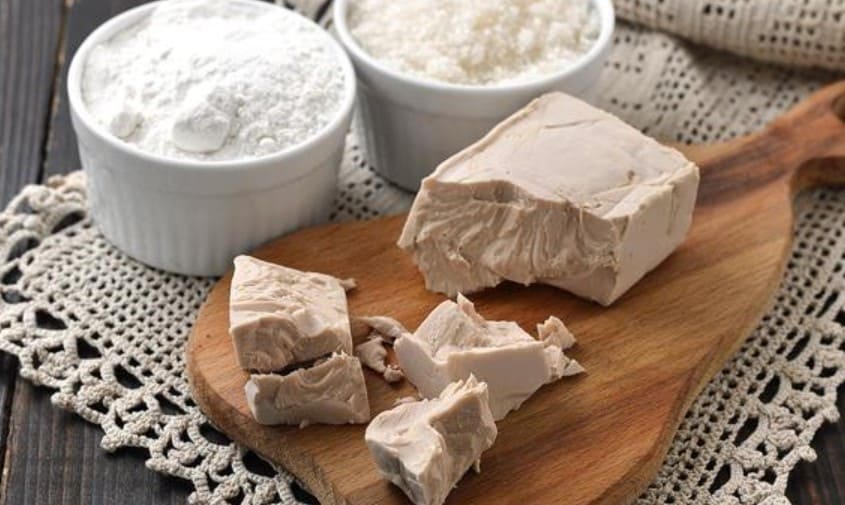
In contrast to fresh yeast (also called block yeast), dry yeast has a much longer shelf life. Fresh yeast has a shelf life of approximately 12 days and must be stored in the refrigerator. However, refrigerated storage is also necessary for dry yeast.
Two packets of dry yeast, each with 7g per packet, correspond to the raising power of one cube of fresh yeast. It is said that one packet of dry yeast or half a cube of fresh yeast is enough for 500 grams of flour. For example, we dose the raising agent in our Focaccia Garden recipe. However, this can vary significantly depending on the recipe. For the Franconian yeast dumpling recipe, there are 30 g of yeast – three-quarters of a cube – and only 300 g of flour.
Another advantage of dry yeast is that it is easier to dose than block yeast. It can also be better mixed with flour.
Would you like to try out your homemade yeast dough in combination with a recipe? Then we recommend our delicious pizza rolls, for example. Our crunchy No-Knead Bread is baked with fresh yeast – but without kneading! Because that’s practically not necessary with “bread without kneading”! For fans of sweet baked goods, we recommend our yeast-plaited recipes.
In addition to the yeast fungi, fresh yeast consists of around 30% water. For the dry form of the yeast, this water is removed and the yeast is thus preserved. The classic yeast that we use for baking consists only of a certain type of yeast fungus and is called baker’s yeast.
How to use fresh yeast correctly?
Fresh yeast is delicate. Direct contact with hot or very cold liquid as well as with salt can affect the motive power. It is, therefore, best to dissolve the yeast with a little sugar and/or lukewarm liquid. However, this is only important if the dough is kneaded by hand.
Is dry yeast the same as fresh yeast?
A pack of fresh yeast (i.e. a cube) contains 42 grams. Basically, a pack of dry yeast corresponds to the raising power of half a cube of fresh yeast: the 7 g from the sachet corresponds to the rule of thumb, so 21 g of fresh yeast. Instead of a cube of fresh yeast, you can use 2 packets of dry yeast.
What is the benefit of fresh yeast?
Fresh yeast should give the baked goods a slightly better taste and also have a higher raising power than dry yeast. For a few recipes like yeast loaf or Berlin pancakes, this is possibly the better yeast.
Can you eat fresh yeast raw?
no There is no evidence that yeast has any harmful effects on our organism. On the contrary. However, pure baker’s yeast should not be consumed pure, as this could lead to flatulence.


Facebook Comments