 John Myers
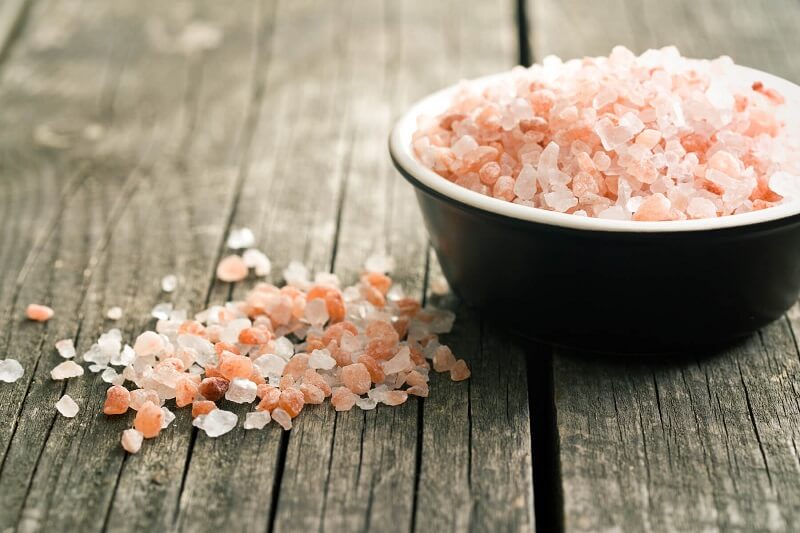
The expensive Himalayan salt is touted as a panacea. However, a health advantage over conventional salt has not yet been confirmed.
The essentials in brief:
- In contrast to conventional table salt, the pink-colored rock salt with 98% sodium chloride has traces of some other minerals.
- However, a particular health-promoting effect has neither been proven nor physiologically comprehensible and may not be advertised.
- Salt enriched with iodine is the better alternative for many in Germany, since the local population does not have an optimal supply of iodine.
- General recommendation: Always use salt sparingly, no more than 6 grams per day.
What is behind the advert for Himalayan salt?
You pay a lot of money for the enticing nickname “Himalaya”: At 4 to 5 euros per kilogram, the pink salt costs 5 to 10 times as much as conventional table salt. The higher price is justified with alleged health benefits.
Various guides and websites praise Himalayan salt as a panacea for many diseases such as gout or high blood pressure. The salt is also said to have a purifying effect and regulate the acid-base balance in the body.
Furthermore, it is described that the salt makes a significant contribution to the supply of minerals. The reason for the special health benefits is often that scientifically untenable statements are made about the special “vibrational pattern” or biophoton energy of Himalayan salt, which is obtained by mining it by hand. In return, conventional table salt is criticized and portrayed as harmful, aggressive or poisonous.
However, these advertising promises have not been scientifically proven. And with the exception of sodium and chloride, the daily need for minerals is by no means covered by the pink-colored salt. The composition of Himalayan salt is 98 percent similar to that of conventional table salt. Only a few other minerals could be detected in traces. The statement “rich in minerals” violates the ban on misleading advertising and the regulations on nutritional claims.
Like Central European salt, Himalayan salt comes from salt deposits that arose from the evaporation and deposition of the primordial sea; the geological history is the same.
Most of the salt is not mined in the Himalayas themselves, but in industrial salt mines in central Pakistan. In a landmark judgment on March 31, 2016, the Federal Court of Justice determined that a supplier may not advertise with the statement “salt from the Himalayan region” if the salt actually comes from the Pakistani province of Punjab, 200 kilometers away. Since then, the salt offered in retail outlets has usually been titled with the addition “from Pakistan” or simply called “pink crystal salt”. Other names are ancient salt, Karakorum salt or Hunza salt.
What should I consider when taking Himalayan Salt?
- The daily intake of salt from all sources should not exceed 6 grams.
- Himalayan salt does not contain iodine. However, most people in Germany do not get enough iodine , so that iodized salt is the healthier option for many. The German Society for Nutrition even recommends table salt that is enriched with iodine and fluoride.
- The use of Himalayan salt as bath salt is unproblematic for healthy people. A really important difference between conventional table salt and Himalayan salt are the transport routes. It doesn’t matter whether it’s the Himalayas or Pakistan: the mining region is a few thousand kilometers further away than, for example, the German salt pans in Rheine, Bad Doberan, Bad Friedrichshall or Bad Reichenhall.
Does the body need Himalayan salt?
An analysis by Stiftung Warentest showed that the sodium chloride content of Himalayan salt varies between 97 and 99 percent. Its composition is therefore very similar to conventional table salt, which has a sodium chloride content of around 98 percent.
The Bavarian State Office for Health and Food Safety has identified a somewhat broader spectrum of minerals as the only difference to conventional table salt. However, instead of the 84 promised, the office only found 8 other minerals in addition to sodium and chloride – and most of them only in minimal traces. Compared to “normal” salt, Himalayan salt contains slightly more iron compounds, which cause the slightly pink tint. Microscopic algae may also contribute to the colouration.
With the exception of sodium and chloride, the daily need for minerals is by no means covered by this salt. In contrast to iodised table salt, Himalayan salt does not contribute to the iodine supply.
Some guidebooks recommend drinking Himalayan salt in the morning as brine (salt dissolved in water). This is supposed to balance the acid-base balance of the body. But the organism regulates this independently. The advice to use brine to lower high blood pressure is highly questionable from a health point of view, because it can not only disrupt the metabolism and water balance, but also put a strain on the kidneys. On the contrary, the extra salt can raise blood pressure even further in sensitive individuals.
The German Society for Nutrition recommends a daily intake of a maximum of six grams of salt from food and table salt for seasoning. Since this amount is often exceeded anyway , the additional consumption of Himalayan salt is not advisable.


Facebook Comments