 John Myers
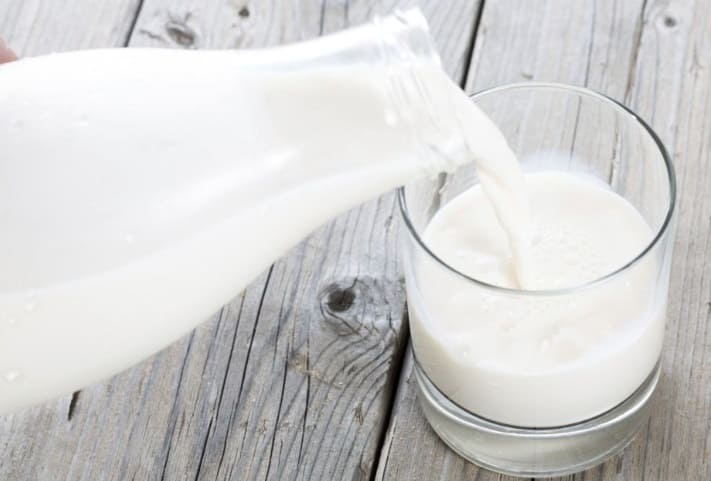
Homogenizing: This is what happens to the milk
Almost all milk is homogenized.
- In chemistry, homogenization means making a uniform mixture from different components that are not soluble in one another.
- In the case of milk, the fat globules contained in the milk are crushed, from an original size of around 10 to 30 µm to a size of around 1 to 2 µm in diameter.
- To do this, the milk is pressed through fine nozzles under high pressure – between 150 and 300 bar.
- Fat and water in the milk then form a homogeneous mixture. Homogenization prevents the fat cream from separating from the water and floating on top.
Homogenizing is not for longer shelf life
Homogenized milk does not keep longer than non-homogenized milk.
- The only reason for the procedure is to prevent the milk from naturally creaming. It’s purely for visuals, as many people would probably consider creaming milk to be spoiled. By the way, we explain whether milk is healthy in another article.
- There is no labeling obligation for homogenized milk. However, you can be sure that this is how milk has always been treated in the supermarket.
- However, you can also buy non-homogenized milk and you don’t necessarily have to go to a farm to do so. Organic milk is not always subjected to this process. Incidentally, there is no labeling requirement for this either. However, the manufacturers usually provide such products with a note.
- If you’re looking for milk that hasn’t been homogenized, look for something that says “unhomogenized,” “natural creaming,” or “may cream naturally.”


Facebook Comments