 John Myers
Contents
show
Make Halloumi Yourself
The perfect make halloumi yourself recipe with a picture and simple step-by-step instructions.
Required utensils:
- 40 drops Lab (animal or vegetarian, as desired)
- 3 tsp Salt
- 1 10 l Topf
- 1 Thermometer
- 1 Stainless steel whisk
- 1 very big Stainless steel bowl
- 1 great Stainless steel sieve
- 1 great Cheesecloth or cheesecloth
- 1 Stainless steel slotted spoon
- 2 size Boards, preferably plastic
Preface:
- Since cheese making is my hobby, the halloumi was “still missing on my list”. It is a semi-hard cheese that originated in the Arab world. But it is now known everywhere and a popular “grill cheese” because it keeps its shape. Since we have a very high consumption of it, and it is not cheap in the supermarket, I dared the experiment and am happy to have found a good alternative.
- It sounds more complicated than it is to make. It is only important when making cheese of any kind that the devices are made of stainless steel or stainless steel so that they can be cleaned as thoroughly as possible. You can get the cheesecloth or cheesecloth on the Internet. Likewise, the rennet, which is available in liquid form in a dropper bottle in animal or vegetarian form and which is so easy to dose. I always prefer to use the vegetarian one. The rennet in powder form is not so well suited for the private production or small quantities of cheese, because you have to dissolve 3 g of powder for 100 l of milk. Difficult to convert with 6 liters of milk.
- I omitted the step of folding after pressing out during preparation. I think it works without it. Regarding storage, it should be said that it can be frozen or stored in the refrigerator in some retained whey. It lasts for a few weeks. So now enough told ….. and get on with the cheese ………. ;-)))
Preparation:
- Clean all utensils thoroughly and very hot before use and rinse with clear rinsing.
- Dilute the lab with water according to the package instructions. Dissolve the salt in a little hot water. Have both ready. Pour milk into the pot and heat it to 35 – 37 ° over a mild heat. When you reach 35 °, turn off the hotplate immediately (you will need it again later) and carefully stir in the rennet and then the dissolved salt with the whisk. Do not move the pot anymore and let the contents rest for at least 1.5 hours.
- When it has expired – the mass must have a similar consistency to curdled milk – go through the mass with the whisk and carefully break it up. Now place the pot on the stove again and heat the mixture to 38 – 40 ° while stirring at a little more than medium heat. Now watch the thermometer every now and then, because this temperature has to be kept for 10-15 minutes. If necessary, always pull the pot briefly from the plate and slide it back again if necessary. The whey is now clearly separating here.
- Line the sieve with the cheese cloth and pour in the mixture in several batches. Always refill when the whey has run through, because this gives you new space to refill. When everything is poured through, let everything drain well in the sieve. Briefly keep the whey that has been collected. Thoroughly clean the pot, then pour the whey back in and put it back on the stove (which is still switched off).
- In the original, place the drained cheese mass on a board, cover with a second board, press out further and plate until a 2 cm thick sheet is formed. Then cut them into rectangles of about 7 x 14 cm. But this is only possible if the mass has not drained too much and is firm. Also in the original, the plates are then sprinkled with salt after simmering in the whey (see point 9) and after lifting them out, folded up once and pressed flat again. This is how the cheese gets the typical gap.
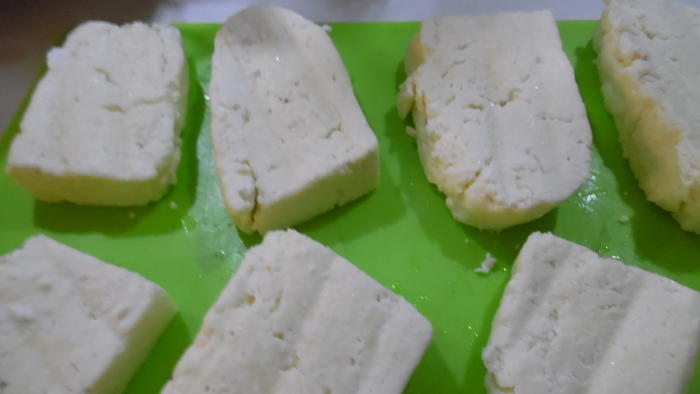
- But I simplified it a little by squeezing the mass more strongly with the cheesecloth and then just plated something between the boards, so that a plate of approx. 5 – 6 cm was created. This then halved and the halves cut into approx. 2 cm thick slices. Then bring the collected whey to the boil and put the slices back in. When all the slices are in the whey, the heat must be regulated so that everything just simmers very slightly and the slices soak for 15 minutes. Skim off the resulting foam with the skimmer.
- Rinse the cheesecloth well under running water, squeeze it out vigorously and spread it out on the oven rack. Place the grid on the tray (as a drip catcher), lift the cheese pieces out of the whey with the slotted spoon and place them on the cloth. Sprinkle the surface with a little salt and let it dry. Then turn the pieces over, sprinkle some salt again, but then place them on one of the boards. As with point 8, the cheese is ready for consumption immediately after cooling. …. fried, grilled, breaded …… everything is possible.
- I was happy with the simplified form. But if you like it a little more complex, proceed as indicated under point 8. The process of simmering in the whey is the same for both options. The type of storage is explained in point 3.
- The amount of 6 liters of milk gave a. 1000 g cheese.


Facebook Comments