 John Myers
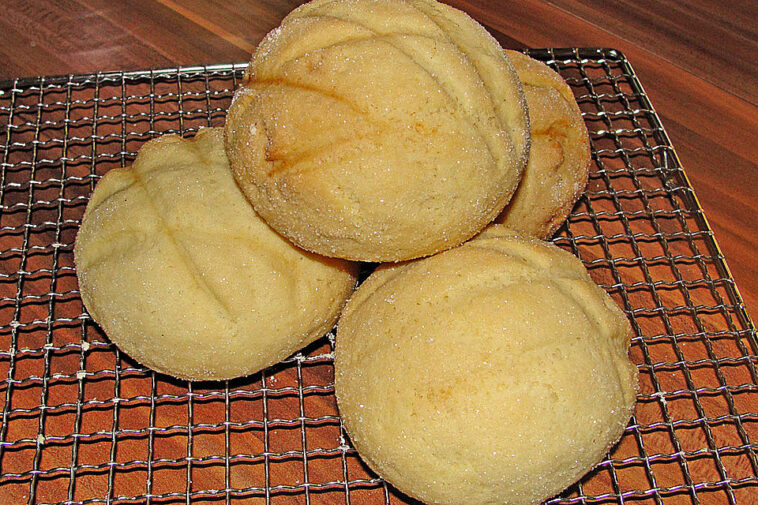
Ingredients for 1 servings:
- 25 g butter
- 35 g sugar
- 25 g egg(s), beaten
- 90 g flour
- ¼ tsp baking powder
- 140 g flour
- 25 g sugar
- 1 tsp salt
- 5 g milk powder, or 5 g milk
- 3 g dry yeast
- 1 tbsp egg(s), beaten
- 70 ml water, warm
- 15 g butter
Instructions
Working time approx. 1 hour 30 minutes; Rest time approx. 1 hour; Cooking/baking time approx. 12 minutes; Total time approx. 2 hours 42 minutes
Japanese “melon bread”, for 5 pieces
Shortcrust pastry (cookie dough): Place the butter in a bowl and beat it with a whisk until fluffy. Then stir in the sugar several times. As soon as the butter mixture begins to turn white, the egg can be added slowly in several stages. In a separate bowl, mix the flour and baking powder. Sift the mixture twice before adding it to the butter mixture and kneading well. Once the dough is well kneaded, shape it into an oblong cylinder, wrap it in cling film, and refrigerate for at least one hour. Yeast dough (brioche dough): Carefully mix the flour, sugar, salt, milk/milk powder, and dried yeast in a bowl. Whisk the warm water with the egg and mix it into the flour mixture. Now turn the mixture out onto a floured work surface and knead it. The dough will still be quite sticky. To counteract this, the dough is thrown onto the work surface several times, brought back together with a scraper, kneaded again, rolled and thrown again. If you repeat this often enough, the dough will be noticeably less sticky. As soon as the dough is no longer so sticky, flatten it slightly and spread the butter on top. The dough is folded over the butter and the butter is carefully worked in. Once it is well incorporated, the dough is kneaded for another 10 minutes and thrown onto the work surface again if necessary. The dough is then shaped into a ball, placed in a bowl, covered with foil and left to rest in a warm place for about 40 minutes. You can tell whether the dough is ready to be used further after the resting time by poking a floured finger into the ball. If the hole closes again immediately, the dough needs to rest for longer. Once the dough has rested long enough, it is weighed and the weight divided by 5. Then you press it flat on the work surface and knead the air out of it. Then you shape it into a cylinder and use a dough scraper to divide the dough into 5 pieces according to the previously calculated weight. These pieces are pulled slightly to the other side, shaped into balls and placed on a floured baking tray. They are then left to rest for another 20 minutes at room temperature. While the brioche dough is resting, you continue to work with the cookie dough. To do this, the total weight is also divided by 5 and the corresponding pieces are cut off. These pieces are rolled into balls and pressed between two pieces of cling film using the dough scraper to form circles with a diameter of approx. 9cm. Once the brioche dough has rested, a cookie circle is placed on each ball. This is then carefully pressed around the ball until the ball is covered. Only the bottom of the ball remains open, so that the brioche dough peeks out. Each coated ball is rolled in sugar along with the cookie dough and cut into diamond shapes. Make sure only the cookie dough is rolled in the sugar! Before the melon pans can go into the oven, they need to rest for another 40 minutes. Then they are placed in an oven preheated to 170°C (350°F) and baked for about 10-12 minutes, until lightly browned. Let cool on a wire rack and enjoy.


Facebook Comments