 John Myers
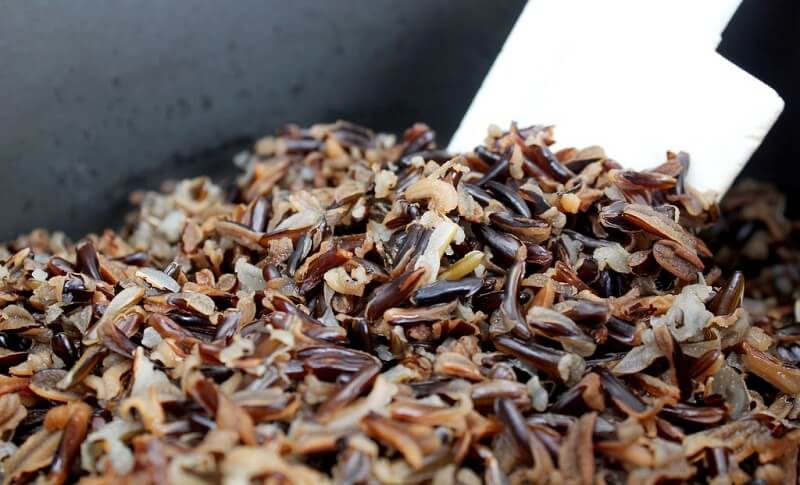
Wild rice is far superior to white rice and healthier than brown rice. Here you can find out how it differs from real rice, how it is cooked and why you should prepare the black grains more often.
Wild rice is not real rice
Wild rice is also called water rice, Indian rice or Canadian rice. Its grains are black and very long, significantly longer and also narrower than the grains of long grain rice. However, wild rice is not one of the more than 100,000 varieties of rice worldwide, as one might assume from its name. Although wild rice and rice both belong to the sweet grass family ( Poaceae ), they come from different genera.
Wild rice belongs to the genus Zizania . It comes mainly from North America and parts of East Asia. Real rice, on the other hand, belongs to the Oryza genus and is mainly grown in Asia, but also in some parts of Italy and Spain.
Since wild rice has a rice-like shape and is prepared exactly like rice, it earned its name. It should not be confused with wild forms of the genus Oryza , which are referred to as “wild rice”.
Wild rice is an aquatic plant, real rice is not
Zizania derives from the Greek word zizánion , which can be translated as “growing in the water”. In fact, wild rice grows in water, namely on the banks of lakes, rivers and ponds. Real rice is also cultivated in wet cultivation on the well-known rice terraces in the water, but the fields are artificially flooded to keep weeds and pests away.
Because real rice is actually not an aquatic plant. It has merely adapted to the high water supply over the centuries that it has been grown this way by developing an aeration system for its roots.
From a purely external point of view, the two green grasses could be confused. However, wild rice forms elongated, dark brown to black grains, while rice grains are usually somewhat shorter and more rounded. In the supermarket, wild rice is almost only available as a wild rice mix – i.e. mixed with conventional rice.
The difference between wild rice and black rice
The difference between wild rice and black rice is not quite as clear due to the similar color. However, the grains of wild rice are darker and also significantly narrower and longer than those of black rice.
Wild rice only turns black when it dries. Previously, its grains have a brownish-green tint.
Black rice, on the other hand, is different black or dark colored varieties of real rice. Black rice is black or dark because anthocyanins are stored in its outer layers. These are secondary plant substances with a violet-black color, which are also responsible for the color of many black and blue berries.
If you peel the black rice, it turns white. Because the anthocyanins are only contained in its outer layers. Thus, black rice is always unpeeled rice (whole grain rice).
Black rice comes mainly from Asia – wild rice, on the other hand, mostly from North America.
Wild rice mostly comes from North America
There are four types of wild rice:
- Three of these – Zizania aquatica , Zizania palustris and Zizania texana – come from North America. If you buy a packet of wild rice from the supermarket, it’s very likely Zizania palustris .
- Zizania latifolia is native to East Asia. Both the grains and the stems of the plant are edible. The stalks are prepared like a vegetable.
The North American wild rice varieties grow predominantly around the Canadian and North American Great Lakes and on the Mississippi. The plants grow up to five meters high. Wild rice has been an important part of the diet of indigenous peoples in North America for over 3000 years.
Wild rice traditionally harvested by indigenous tribes
The older generations of the indigenous peoples of North America still harvest wild rice in the traditional way: sitting in a boat, they bend the stalks forward with wooden sticks and knock the grains out over the boat.
When the stalks spring back, some of the grains end up in the water, where they can be used as seeds for new plants. In this way, the stalks are not damaged and only enough is harvested to preserve the natural stock.
The long grains are then dried in the sun or over a fire, turning them from greenish-brown to black. Finally, they are dehusked – that means the fine shells around the grains are removed.
Modern wild rice harvest: Large part from farms
However, since the demand is greater than the tribes can harvest, 90 percent of the world’s wild rice now comes from American farms. So not only is wild rice not rice, it often doesn’t even come from wild growth, making the term “wild rice” entirely misleading.
The plants, most of which are high-yielding hybrids, are cultivated in large water basins and harvested mechanically using combine harvesters.
In industrial drying, the wild rice is then heated to 135 degrees for two hours in a huge rotating tube and dehusked. Sometimes the outermost layer is scored as fine as a hair to reduce the cooking time.
Grains that break during processing are sorted out and then end up mixed with conventional rice, used as animal feed or processed into flour.
The harvesting methods of the indigenous peoples have also become more modern in order to be able to keep up with the farms. Because the wild rice harvest is often their only source of income. Harvesting with airboats is no longer uncommon and the indigenous population has set up their own factories in which they dry, roast and pack the rice.
Recipes with wild rice
Wild rice has a strong, nutty aroma, making it an excellent alternative to real rice. It can be used in almost any dish that would normally use real rice.
The combination of real rice and wild rice is popular – for example in a curry, in a rice pan or with all kinds of vegetables.
The table: nutritional values, vitamins and minerals of wild rice
Like real rice, wild rice is low in fat and calories. Its protein content is more than double that of real rice. Also, its fiber content is slightly higher than that of brown and white rice, as you can see from the nutrition facts table.
White rice is hulled and therefore contains less vital substances than wild rice and brown rice. Since wild rice, like brown rice, is not husked but only dehusked, it is most comparable to brown rice:
- Except for vitamin B12, all B vitamins are contained in wild rice. Although the values are for cooked rice and the B vitamins are heat sensitive, wild rice and brown rice can at least help meet the daily requirement for B vitamins.
- Wild rice provides more vitamin B2, vitamin B3 and folic acid than brown rice.
- Brown rice and wild rice contain about the same amount of calcium and magnesium, which is 3 times the magnesium and 4 times the calcium of white rice.
- Wild rice contains twice the potassium of brown rice and 6 times the potassium of white rice.
- 100g of cooked wild rice contains 3.5 times more zinc than the same amount of brown rice and 10 times more zinc than white rice. The wild rice thus covers a quarter of the daily zinc requirement (if you eat 100 g of it).
The health properties of wild rice
Hardly any studies have been carried out on wild rice. However, researchers suspect that consuming the water rice may prevent cardiovascular disease due to its antioxidant effects.
In traditional Chinese medicine, it is used to treat digestive problems and diabetes. It is also said to strengthen the kidneys and bladder and have a slightly diuretic effect.
Wild rice has an antioxidant effect
Wild rice is rich in antioxidants — 30 times more than white rice, Canadian researchers have found. The antioxidant effect is mainly attributed to the substances epicatechin, epigallocatechin, rutin and some phenolic acids and vitamin E and of course to the anthocyanins mentioned above . The first two substances are also partly responsible for the antioxidant properties of green tea.
Antioxidant substances reduce oxidative stress in the body. An excess of oxidative stress increases the risk of almost all chronic diseases such as Parkinson’s, Alzheimer’s, stroke, cardiovascular diseases and cancer.
The glycemic load and glycemic index of wild rice
Wild rice, with a glycemic load of 25, has less of an impact on blood sugar than white and brown rice, both with a glycemic load of over 30. For this reason, it is better than real rice, especially for people with diabetes.
But it also makes sense to eat foods with a low glycemic load for all other chronic inflammatory diseases, since blood sugar fluctuations have a pro-inflammatory effect, which can be prevented with a low-glycemic diet.
Wild rice in case of intolerance
People suffering from histamine intolerance , gluten intolerance or lactose intolerance can breathe a sigh of relief. Because wild rice is not a histamine liberator and contains neither histamine nor gluten nor lactose and is also generally considered to be well tolerated.
Buy wild rice in organic quality
As a rule, wild rice can only be found mixed with conventional rice in the supermarket. On the other hand, you can buy pure wild rice in delicatessens, health food stores or on the Internet.
Most of the organic wild rice found in health food stores comes from Saskatchewan, Canada. In the lakes there, certain areas for organic wild rice are marked out and the water quality is regularly checked. The use of pesticides and chemical fertilizers is of course not permitted.
Harvesting and processing are still carried out there in a largely traditional way – whereby the wild rice is no longer harvested by hand but with airboats. Local wild rice organizations encourage the participation of tribal peoples and their descendants in harvesting. Because the yields are lower than the low-cost cultivated wild rice found in the US, the price of this wild rice is slightly higher.
This is how wild rice is prepared
Wild rice is prepared in a similar way to regular rice. You only need three to four times as much water as wild rice. Because the grains are sometimes scored to reduce cooking time (the grains absorb water better this way), cooking times can vary widely. Scored wild rice takes 30 minutes maximum.
Wild rice that has not been scratched, on the other hand, needs to cook for around 50 minutes. The size of the grains also affects the cooking time. To shorten the cooking time further, you can soak the wild rice for an additional hour or two beforehand.
The information on the soaking and cooking time is best found on the packaging, because it is usually not specified whether the rice is scored or not. The scratches are also hair-thin, so you can hardly see them.
With a mixture of wild rice and rice, on the other hand, around twice the amount of water is sufficient, since it usually only contains around 15 percent wild rice. Blends use extra fine grains or grains that are broken during processing to reduce cooking time and allow the wild rice to be cooked like regular rice. Wild rice doesn’t get quite as soft as rice but retains a nice bite.
This is how wild rice is stored
Wild rice should be stored dry, dark and tightly closed – this way it lasts almost forever.
Arsenic in wild rice?
Like regular rice, wild rice can be contaminated with arsenic. There are currently no current analyzes of wild rice – only the results of an American study from 2000.
The arsenic content was increased by 0.11 mg/kg. However, it did not exceed the current limit for inorganic arsenic in rice and also contained much less arsenic than real rice. For comparison:
- White rice: 0.2 mg/kg
- Whole grain and parboiled rice: 0.25 mg/kg
Arsenic occurs naturally in soil and water. Since rice and wild rice plants require a lot of water and are usually grown in standing water, they absorb more arsenic than other cereals.
You can easily reduce the arsenic content of wild rice and rice by washing the grains several times with water before cooking. Soaking wild rice for several hours also reduces the arsenic content and also shortens the cooking time.
Phytic acid in wild rice
Like real rice (and like any other grain), wild rice contains phytic acid. We do not have exact values, but it can be assumed that the phytic acid content is comparable to that in brown rice, because the phytic acid is mainly found in the outer layers of the grain . As a result, paddy rice and wild rice contain more phytic acid than white rice.
However, the phytic acid content can be reduced by soaking for several hours – for example overnight. Then pour away the soaking water.
Conclusion: Is Wild Rice Better Than Rice?
Wild rice is a healthy and nutritionally valuable food. The paddy rice contains more protein and fiber than real rice and is low in fat and calories. Even when cooked, it helps to cover the need for B vitamins and provides a lot of zinc and antioxidants.
It is also well tolerated and puts less strain on the blood sugar level than real rice. Wild rice is far superior to white rice and performs better than brown rice in our comparison.
Its nutty aroma also goes well with a variety of dishes – it tastes particularly good in combination with vegetables, in a stew or with curry. All in all, wild rice is a great addition to a healthy, plant-based diet.



Facebook Comments