 John Myers
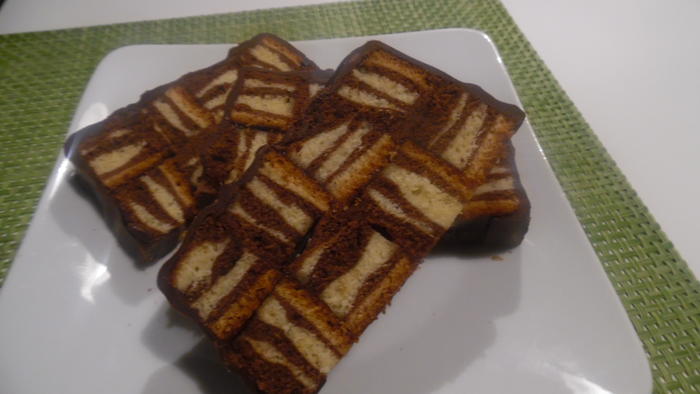
Stripe Cake
The perfect stripe cake recipe with a picture and simple step-by-step instructions.
- 5 Eggs
- 250 g Sugar
- 125 ml Water
- 250 g Cooking oil
- 400 g Flour
- 1 Pck. Baking powder
- 40 g Cocoa
- 1 Pck. Vanilla flavor
- 100 g Light fruit jelly (e.g. apple, quince or apricot)
- 350 g Dark couverture
- Separate eggs. Beat egg whites until stiff. Keep ready. Beat the egg yolks and sugar whitish and frothy until the mixture has doubled. Stir in water and oil.
- Mix the flour and baking powder, sift into the egg mixture in several portions and stir in. Finally fold in the egg whites.
- Divide the dough into 2 portions, whereby there should be 2 tablespoons more of the one (later light). Then stir in the vanilla flavor into this and the cocoa into the other, slightly smaller portion. Since this makes the mixture a little tougher, stir in about 2 – 3 tablespoons of water so that this dough has the same consistency as the light one.
- Preheat the oven to 250 °. Line the tray with baking paper.
- Now the two doughs are baked alternately – similar to the Baumkuchen – one after the other as follows: Take enough of the light-colored dough that you can spread it 3 mm thin to form a rectangle of approx. 25 x 35 cm. Then slide the tray into the oven on the top rail and bake for 3 – 5 minutes. The previously shiny surface of the dough must have a “matt” shimmer, then it is bush hammered.
- Continue doing this until both types of dough are used up. In the case of the thickness of the layers, however, it is not essential that they are exactly the same.
- Take the tray with the finished dough sheet out of the oven after the last baking process and let it cool down slightly but not completely. Then pull this with the baking paper from the baking sheet onto a work surface and cut the edges with a sharp knife so that a neat rectangle is created.
- Stir the fruit jelly a little, but do not heat it up and keep it ready.
- Now measure the thickness (height) of the dough sheet. Take these determined centimeters as a measurement and cut lengthways strips that are just as wide. Spread out a large piece of cling film (it has to be big enough that the cake can be wrapped with it later), smooth it out and now place 3 strips loosened from the paper lengthways next to each other so that the cut surface or the surface is alternately on top. Always spread the jelly over the sides that are lying next to each other and press them well against each other. Now spread the jelly onto the entire 1st layer and place the 2nd layer on it. Now arrange the strips so that the one with the intersection facing up is now the one with the surface facing up and vice versa. This is how the pattern is created. Again, spread the jelly generously on the sides that are lying next to each other and press against each other but also at the same time on the lower layer.
- Now wrap the resulting box-shaped cake strand tightly and tightly with the protruding cling film and put it in the refrigerator for about 1 hour.
- Then melt the couverture over a medium heat over a water bath. Take the hardened cake out of the refrigerator, remove the foil and place it on a mat. Then coat generously with the couverture.
- This cake may be a “little tinker”, but it sounds worse than it is. In terms of taste, it is like the conventional marble cake, but not dry due to the thin layers of jelly ….. and due to the pattern a small “eye-catcher” for every coffee table.


Facebook Comments