 John Myers

Ingredients for 1 servings:
- 500 ml mineral water, still
- 1 tbsp rock salt, untreated
- 300 g carrot(s), organic
- 1 small onion(s), organic
- 5 g ginger, organic, fresh
- 5 g turmeric, organic, fresh
Instructions
Working time approx. 10 minutes; Rest period approx. 7 days; Total time approx. 7 days 10 minutes
simple and delicious beginner’s recipe
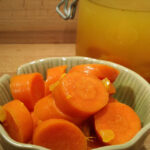
For fermentation, you’ll need a clean screw-top or preserving jar with a capacity of approximately 700 ml, in addition to the listed ingredients. For the brine, completely dissolve the salt in the water while stirring. Now prepare the vegetables: Wash and trim the carrots, then slice them not too thinly (approx. 6-8 mm). Peel and dice the onion. Peel and finely grate the ginger and turmeric. (Caution: fresh turmeric stains very strongly and permanently. If yellow stains bother you, don’t use your favorite cutting board.) Now put everything in the clean jar and pour in the brine. Leave about 3 cm of space to the rim. You will need about 300-400 ml of the prepared brine. Now cover the jar loosely, i.e. just put the screw lid on and do not close it tightly. Let it ferment for 3-7 days at room temperature and check the ferment every day. It is ready when it tastes light and pleasantly lactic acid. Then close the ferment tightly and store it in the refrigerator. Just be careful when opening it: the cold in the refrigerator does not stop the fermentation process, it only slows it down. Therefore, some gas (carbon dioxide) escapes every time you open it. Theoretically, the ferment will keep for several months in the refrigerator. However, always use a clean spoon to remove it from the jar. A few general tips and notes on fermentation: 1. To prevent mold or similar growth, you need to work cleanly during fermentation. The jar for the ferment, in particular, should be very clean. But don’t panic too much about mold, and it’s okay. Fermentation is a tried-and-tested method of preserving food. If you follow normal kitchen hygiene rules, almost nothing can happen. 2. The salt for the brine must be natural. Do not use salt with added iodine or fluoride. 3. I have found that beneficial lactic acid bacteria thrive in still mineral water than in tap water. I have observed this many times with my sourdough for baking bread. Therefore, I recommend using still mineral water here as well. 4. During fermentation, the ferment must always be sufficiently covered with brine. Therefore, add more brine if too much has evaporated during the fermentation process. Even if the vegetables are pushed upwards by the resulting gas, stir once to allow the gas to escape and then push the vegetables down. 5. The exact fermentation time depends on various factors and can therefore only be given in relatively long time spans. Here are a few rules of thumb: – The colder it is, the slower the fermentation process. This means, for example, that fermentation in an unheated kitchen takes longer in winter than in summer. – The fermentation process is also determined by which lactic acid bacteria multiply. Since no starter cultures are added during traditional fermentation, the lactic acid cultures come from the environment, for example from the vegetables used and from the air. For this reason, the use of organic vegetables is recommended. – During the first ferment, the few lactic acid bacteria that live on the vegetables have to multiply laboriously and this takes time. If you want to start new ferment after the first fermentation, you can add a splash of the old brine to the new ferment. This ensures more lactic acid bacteria in the jar right from the start, and the fermentation process speeds up. 6. Always trust your senses: You should check on the ferment and test it periodically during the fermentation process. As with all foods, the rule is to look first, then smell, and only then taste: – Look: During the fermentation process, you can initially see gas forming (small bubbles that rise to the top when you move the jar slightly). Over time, the brine also becomes slightly cloudy. – Smell: The ferment smells increasingly slightly sour. Not as pungent as vinegar, but milder. – Taste: At first, it tastes as pure as the fresh ingredients, only a little saltier because of the brine. As fermentation progresses, the taste becomes more sour. The acidity here is also not like vinegar, but milder. It tastes typically lactic acid. You should also pay attention to the consistency. Carrots, for example, do not become softer through fermentation and retain their bite. If you find anything objectionable during any of the tests, please do not use the ferment.


Facebook Comments