 John Myers
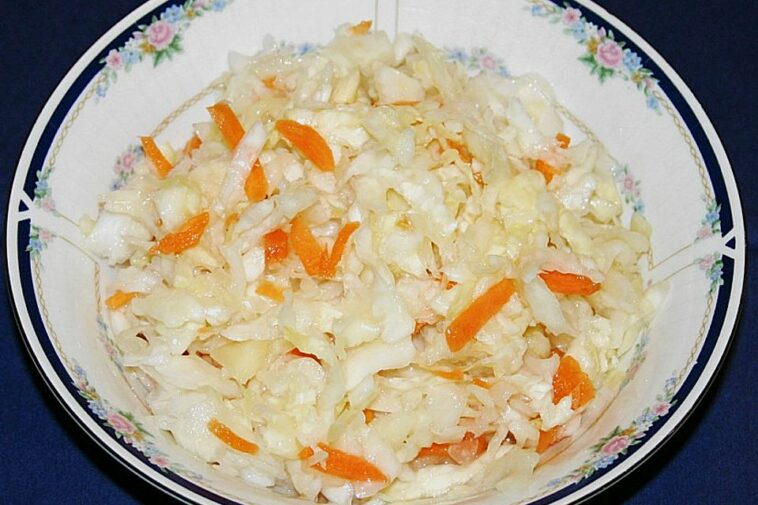
Ingredients for 1 servings:
- 1 head of white cabbage, Turkish
- 500 g carrot(s)
- Salt, coarse, 2/3 cup
- ½ cup sugar
- 10 liters of boiled water
Instructions
Working time approx. 30 minutes; Total time approx. 30 minutes
Ready in a week – vitamin-rich, crunchy and delicious
To prepare sauerkraut, you need a slicer, as it allows you to optimally slice even large quantities of white cabbage – the strips should be about 5 mm thick. Such slicers are available at hardware stores, for example, and look like a large wooden board with an integrated wide steel blade. For smaller quantities (1-3 kg), a regular household slicer will suffice. You will also need a few utensils: a clay fermentation crock (from a hardware store) or a large enameled pot (undamaged, of course); a round wooden board with a diameter slightly smaller than the opening of the pot (a steak board works well for this), a cotton cloth about twice the size of the opening of the pot, a clean wooden stick, and a weight weighing about 2-3 kg (there are special stones for the fermentation crock, but a 2-3 liter glass of water will also work). Preparation: Slice the white cabbage and coarsely grate the carrots. For one large “head” of white cabbage, you will need about 500 grams of carrots. Make the marinade: Dissolve salt and sugar in boiling water, let it cool completely. Mix the shredded cabbage and grated carrots, and place it in the fermentation pot. Pour the marinade over the cabbage so that the cabbage is completely covered. Place the cotton cloth on top so that the corners extend far out. Place a wooden board on top of the cloth, fold the corners over the wooden board, and place the weight on top. Let the cabbage stand at room temperature (20-22 degrees Celsius) for 3-4 days, preferably near a radiator—but don’t turn up the heat, just use normal heat. Remove the weight daily and rinse the cotton cloth under running water. Pierce the cabbage with the wooden stick 1-2 times a day, right down to the bottom of the pot—this releases the fermentation gases, which can otherwise negatively affect the cabbage’s flavor. After this time, divide the cabbage into clean jars, seal them, and refrigerate for 2-3 days to mature. Successful sauerkraut is crisp, has a pleasant, sour flavor with a slightly sweet note (which diminishes over time), and smells truly appetizing. In sealed jars, the sauerkraut can be kept in the refrigerator for up to three months without any loss of flavor. Homemade sauerkraut is very popular in Russia. However, it is only eaten cold as a zakuska (appetizer): on its own, as a salad with a little oil and onion to taste, or in a salad called winegret, which consists of sauerkraut, beetroot, red beans, and potatoes. Sauerkraut pairs very well with strong, neutral-tasting spirits like vodka or schnapps. In my opinion, the regular white cabbage sold in supermarkets is too hard and dry for this dish. The best white cabbage is one that is not round but somewhat flattened and has thick, juicy, and crispy white leaves. This type of white cabbage can be found in Turkish grocery stores or sometimes at markets.


Facebook Comments