 John Myers
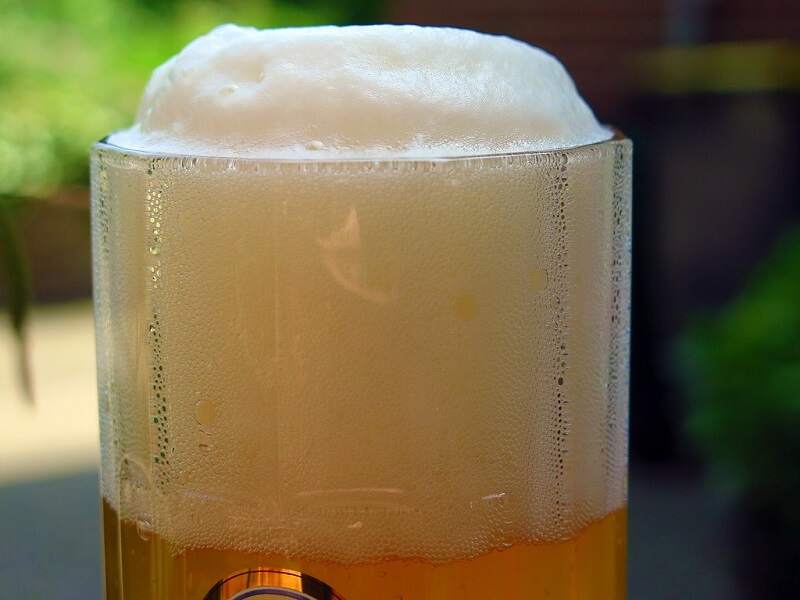
After a marathon, a cool, non-alcoholic wheat beer – makes sense or just successful marketing? We explain whether alcohol-free beer is really suitable as a drink for athletes.
That’s what it’s about:
Non-alcoholic beer is touted as a sports drink
Anyone who has ever taken part in a fun run knows it: there is free water for the athletes at the finish. Sure, the sweaty athletes have to replenish their fluid stores. One stand further there are mugs with non-alcoholic (wheat) beer. Manufacturers such as Erdinger, Krombacher or Bitburger regularly sponsor such events. They explicitly advertise their alcohol-free products as isotonic sports drinks that are supposed to help with regeneration.
This apparently typically German thing got international attention at the 2018 Winter Olympics. According to media reports, Krombacher sent 3,500 liters of non-alcoholic beer (and 11,000 liters with alcohol) to the national team in Pyeongchang. The athletes expressed their gratitude, saying things like “It tastes good and it’s good for the body” to the press.
The advantage of alcohol-free beer over water seems as simple as it is obvious – it is isotonic and contains important nutrients . Isotonic means that due to a certain density of dissolved particles, they get into the blood faster. This allows the body to recover better – it gets back all the substances that it previously used up under exertion and sweated out without any time delay. That’s the theory, but how does it work in practice?
So we should talk about it:
There are actually no meaningful studies
If you ask the manufacturers what scientific facts their advertising slogans are based on, they all have various studies at hand. They have to, because they are subject to the so-called Health Claims Regulation . This regulates Europe-wide which nutritional and health-related information may appear on products. To ensure that consumers are not misled with false promises, one of the principles of the Health Claims Regulation is that any connections between the product and health that are suggested must be scientifically proven.
This does not mean, however, that every beer manufacturer first has its 0.0% drink served by researchers to hundreds of amateur athletes. Instead , evidence of various ingredients , such as potassium, is sufficient. If the micronutrient is present in a certain concentration, it can help with regeneration: Potassium is needed in the body to replenish the energy stores in the muscles and this has been scientifically proven. It is similar with other ingredients, including carbohydrates or vitamins – the specific effect has been proven, but not necessarily in the context of non-alcoholic beer.
The studies that have actually examined the effect of the drinks in training or competition lack meaningfulness. Some are financed by the manufacturers themselves. Most problematic, however, is that there are usually too few test subjects taking part, often no more than 20. The results of such small studies, on the other hand, are notorious for being biased. And that’s for the benefit of what they’re testing.
But:
It probably won’t do any harm either
One thing is clear: If you do a lot of sport, you burn calories and sweat a lot. Fluid and salts are lost in the process. After the effort, it has to be brought back in, for example with mineral water and a snack or with an isotonic drink. In addition to non-alcoholic beer, there are many other products on the market that fall into this category. They all provide a quick supply of nutrients, because the term “isotonic” is also subject to the health claim regulation. What’s on it has to be inside. The “inside” definitely deserves a critical look: A sugar-water solution could also be isotonic in the right mix ratio, but wouldn’t really be healthy.
So if the list of ingredients is correct and the 0.0% beer contains carbohydrates and electrolytes such as sodium, potassium, magnesium or chloride, you can easily reach for the bottle to quench your first thirst. It won’t hurt. But it doesn’t help you to achieve Olympic achievements either.
And now?
Try it, but please without alcohol
A British meta-study that analyzed other research on sports drinks came to the following conclusion: The best thing to do is try out what is best for you using the trial-error method . So test according to the principle of “trial and error”. Alcoholic products are of course an exception to this: they dry out the body even further and hinder muscle regeneration.
It doesn’t matter whether it’s alcohol-free beer, water with fizzy tablets or a ready-mixed sports drink – in the end it is all about drinking enough liquid . Individual taste can also be decisive, says Günter Wagner from the German Institute for Sports Nutrition. “What you like best, you consume more – and most people don’t drink enough after exercise.”
Incidentally, isotonic drinks can also be mixed at home : add one part apple juice to three parts mineral water. The composition of the mineral water is important, it should contain all the important electrolytes. “Water low in minerals, which is used to prepare baby food, for example, is not suitable,” says ecotrophologist Wagner.

Facebook Comments