 John Myers
According to a popular theory, the amount of protein in our food determines when we are full. Is that correct? And if so, why?
What actually decides when we are full – and how quickly? One theory is the so-called protein leverage hypothesis. The idea: It is mainly the protein in food that fills us up. The question is: Is that true – and if so, how does it work?
Why does our body need proteins?
Our food consists of three main nutrients: fats, carbohydrates and proteins. Proteins are made up of subunits called amino acids. There are a total of 20 of them. Our body can produce twelve of them itself, but not the other eight – we have to absorb them through our food. These eight are called essential amino acids.
Signal and building materials of the body
Proteins are very important to us: They are the body’s signaling and building material. Muscles are made up mostly of protein, just like the brain and hair. As structural proteins such as collagen, they hold our body together, as enzymes, they ensure that our metabolism works, as hormones and receptors, they send signals through the organism, as blood clotting factors, they prevent us from bleeding to death. They are the translators of our genes into a functioning organism. In short: nothing works without proteins.
The German Society for Nutrition (DGE) recommends that adults should consume 0.8 grams of protein per kilogram of body weight per day. For some, the recommended amount is higher: 1 to 1.5 grams for breastfeeding women and 2 grams per kilogram of body weight for athletes.
Does the amount of protein in our food control when we are full?
In 2005, the British researchers Stephen Simpson and David Raubenheimer formulated their protein leverage hypothesis for the first time: According to their results, the amount of protein in our food alone determines whether and when we are full. So we keep eating until our body gets the dose of protein it needs.
The problem with this: We rarely eat pure protein, we almost always eat fats and carbohydrates. If there is little protein in the diet, we eat more overall. The fats and carbohydrates then end up in our stomach “by the way” – and ultimately on our hips.
Many researchers assume that the way we eat today can increasingly lead to obesity. Because finished products and industrial food often contain little protein, but a lot of fat and carbohydrates – and therefore a lot of calories in a small amount. In order to satisfy our protein hunger, we consume significantly more energy than we need. That’s the theory.
The hypothesis has since been widely tested and confirmed, in both animals and humans. However, it is not undisputed. Some researchers could not prove the effect in studies and postulate that something else is responsible for whether we feel full: fats.
How does protein affect our feeling of satiety?
Proteins are converted to heat more than other nutrients
Unlike carbohydrates and fats, proteins have a high thermogenesis. This means that our body converts around 20 percent of its energy content into heat – and not into fat. At the same time, this also increases our basal metabolic rate: In order to maintain the high temperature, we use more energy that is not stored as fat.
Blood sugar stays more even
When we eat a candy bar or white bread, our body has a lot of carbohydrates available. The result: Our blood sugar (and thus also the insulin) rises quickly and sharply. If the blood sugar drops again, we get hungry – especially for fast blood sugar suppliers such as sugar.
The influence of a food on the blood sugar is called the glycemic index, the reference here is glucose. Proteins have a low glycemic index – blood sugar doesn’t rise as quickly and as high as after a carbohydrate snack. The result: the feeling of hunger afterwards is not as strong.
Hormones fill us up
When proteins arrive in our stomach, the body begins to break them down: first into peptides, then into amino acids. These breakdown products pass from the stomach into the small intestine, where they signal the body to produce hormones. These include cholecystokinin, peptide YY (PYY) and glucagon-like peptide 1 (GLP-1). They send the signal “full” to the brain. The amount of leptin (the “satiation hormone”) increases, ghrelin (the “hunger hormone”) decreases.
At the same time, the hormones also act directly in the stomach: they ensure that the digested food leaves the stomach more slowly – the stomach stays full longer. This also increases our feeling of satiety and prevents us from eating something again quickly.
The proteins also have an impact on our reward system in the brain: Actually, our brain likes it when we eat. If the food is tasty, he’ll appreciate the reward and want more. But: If there is a high protein content in the food, this reward system is slowed down. Eating is no longer perceived as the ultimate kick, the desire to continue eating is less strong.
Some of these molecular mechanisms cannot be attributed to proteins alone; PYY, for example, is also activated to a large extent by fat. This could be one reason why the study results on the feeling of satiety are partially contradictory.
Can you eat too much protein?
If protein keeps us full, lean, and healthy, can we, in good conscience, eat steak and eggs every day? First of all, we should of course make sure that our food remains balanced, i.e. that we eat enough vitamins, fiber and other nutrients. But apart from that, a high-protein diet can also have other side effects.
If you eat a lot of protein, the pH value in the stomach becomes significantly more acidic. To compensate for this, basic ions are needed – bones are a good reservoir of basic compounds. However, when they are released, important calcium is also released. The result can be unstable bones and osteoporosis.
Stress on the kidneys and acidosis
In addition, when proteins are broken down, a lot of urea is formed. The body wants to get rid of it, so it needs a lot of fluids. And the kidneys also have to work hard for this. In the long run, they can be damaged – also because they do not tolerate the large amounts of stomach acid well. Researchers also suspect a higher risk of kidney stones if we eat a high-protein diet.
“High-protein” is therefore not recommended for people who have kidney problems or acidosis. But there may be a way out: vegetable proteins.
Is animal or plant protein better?
Similar = better?
For a long time, the conventional wisdom was that animal proteins are more suitable for humans than vegetable ones. Although proteins from animals and plants always consist of the same amino acids, the composition differs: the combination of amino acids in animal proteins is very similar to that of our body’s own proteins.
The technical term for this is biological value: the body has to add few of its own substances in order to achieve an optimal combination of amino acids. Plant proteins are often more “incomplete”, less similar in composition to human proteins. This is often due to just one or a few amino acids that occur below average. However, these “incomplete” proteins probably trigger an even stronger feeling of satiety than those with an optimal combination of amino acids. Vegetable proteins make you even fuller than animal ones.
Risk of acne, osteoporosis, cancer and cardiovascular disease
Unlike vegetable proteins, animal proteins stimulate the growth factor IGF-1. What is optimal for building muscle can have unsightly side effects: an excess of IGF-1 promotes acne and can promote the formation of cancer.
In general, it has been widely shown that the more red meat (i.e. pork and beef) and processed meats, such as sausage, you eat, the risk of cardiovascular disease and cancer increases. This effect is particularly strong when there are other risk factors such as smoking, obesity, a lot of alcohol consumption and little exercise. Animal proteins also contain significantly more sulphur-containing amino acids than vegetable proteins, and these are largely responsible for the acidification of the stomach already mentioned. This then leads to minerals such as iron, potassium and calcium being withdrawn from other important places in the body – for example the bones.
Plant proteins also have a positive effect on the intestinal flora: the species composition shifts so that fewer calories are absorbed in the intestine.
Desirable side effects
A plant-based diet also has a number of advantages independent of the direct protein context: legumes contain (in addition to a lot of protein) also a lot of vitamins, folate and minerals such as iron, magnesium and zinc. Plants generally have a lower energy density than animal foods and they contain more fiber and water. Means: They contain fewer calories with more volume – the stomach signals “stop!” faster.
And: If we eat a lot of plant-based foods, this leads to the formation of short-chain fatty acids, which activate the well-known hormone PYY, which suppresses appetite. They also act on GLP-1, which delays gastric emptying. They also promote the production of glucagon, the antagonist of insulin. Many plant-based foods also have an effect on the next meal – we are less hungry and full more quickly.
But it is important to note that not every plant-based product is completely healthy. If you consume sugared compote, juices or potatoes in excess, the carbohydrates are in the foreground again and the healthy effect of the proteins is gone. In general, the less processed a food is, the healthier it is.
Which foods contain the most protein?
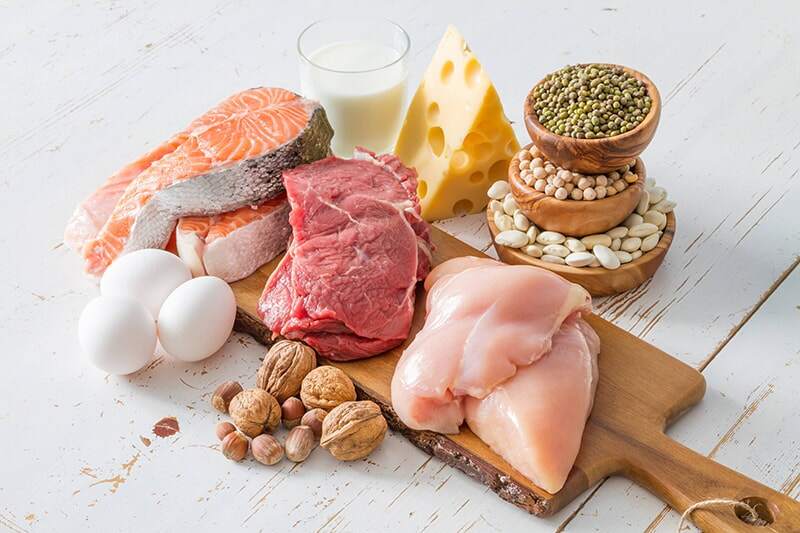
Most will know that animal foods like fish, lean meats, cottage cheese, yogurt, eggs, and cheese are high in protein. But plants can also be real protein bombs. Legumes such as lentils, peas, chickpeas, peanuts and soy products such as tofu are particularly popular here.
But nuts and almonds, kernels and seeds such as chia seeds and pseudocereals such as amaranth, quinoa and buckwheat are also very high in protein. Even among vegetables there are unexpected sources of protein: spinach, broccoli, and cabbage are good sources of protein, among others.
And now?
The protein leverage hypothesis has not been proven beyond a doubt. But a growing body of research suggests that proteins play a very important role in determining when we are full. And one thing is clear: protein is very important for our body. However, there are risks associated with an excessively high-protein diet if you suffer from kidney problems such as kidney failure.
And those who cover their protein requirements mainly with meat are exposed to other risks. If you are not sure, it is best to ask your doctor or slowly change your diet. At the end of the day, every body and every person is unique. There are recommendations and theories, but everyone has to find out for themselves what kind of food suits them best.



Facebook Comments