 Elizabeth Bailey
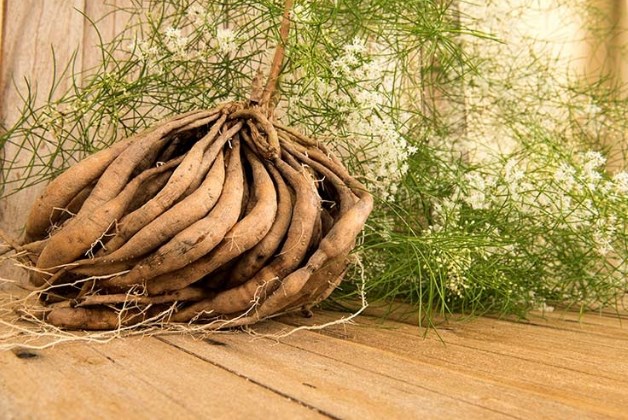
Shatavari is a root that is very popular in Ayurveda among women because of its multiple effects on the reproductive system: menopausal symptoms, menstrual pain and premenstrual syndrome are just a few uses. Find out everything about taking the aphrodisiac here.
Shatavari to increase fertility
Shatavari is one of the most popular Ayurvedic medicinal plants. It is mainly taken by women to increase fertility, with irregular menstrual cycles and with menopause and menstrual problems.
Shatavari (Asparagus racemosus) is a plant of the asparagus family, also known as wild asparagus or Indian asparagus. However, Shatavari has little to do with the conventional asparagus that ends up on our plates.
The climbing plant with its soft, needle-shaped leaves grows mainly in India, Nepal, Sri Lanka, and parts of Australia. It prefers stony ground at altitudes of up to 1500 meters, which is why it can be found, for example, at the foot of the Himalayas.
However, it is not interesting what grows above the ground – because the coveted ingredients are mainly found in the numerous thick roots of the plant. The roots are dried and ground into a fine powder (called “churn” in Ayurveda), or an extract is obtained from them.
Shatavari: The Queen of Herbs
Shatavari powder has been used in Ayurveda – the traditional Indian health system – for centuries. Shatavari is Sanskrit and translated means something like “the woman who has a hundred husbands”.
The translation already indicates the effects that the root is said to have: It is said to increase fertility by stimulating the libido and gently rebalancing the hormone balance. In addition, the Indian asparagus is said to be able to prevent inflammation of the uterus and ovaries. The plant is also known as the queen of herbs and symbolizes love and affection.
Shatavari also has a calming and pain-relieving effect and can help with insomnia and digestive problems. Therefore, men can also benefit from it.
The plant is also known to the Aborigines: some indigenous tribes in Australia use the liquid from the boiled roots externally to cleanse the body in case of colds and to treat wounds.
The Effects of Shatavari
In studies so far, the following properties of Shatavari have been identified. The plant works, among other things:
- antioxidant
- antidepressant
- nerve-wracking
- antispasmodic
- analgesic
- anti-inflammatory
- anxiolytic
- aphrodisiac (increases libido)
- milk-promoting (stimulates the formation of breast milk)
Although large clinical studies are still lacking, experience from Ayurveda, studies on animal models, and smaller clinical studies indicate that Shatavari has great potential.
The ingredients of Shatavari
So far, more than 50 ingredients have been identified in Shatavari, including saponins (e.g. Shatavari), flavonoids (e.g. isoflavones and kaempferol), glycosides, alkaloids (e.g. asparagine), polysaccharides and mucilage.
Isoflavones are phytoestrogens, i.e. plant substances that are similar to human estrogen and can dock to the estrogen receptors in the body. Although they are significantly weaker than the estrogen in the human body and are therefore not a full estrogen substitute. However, phytoestrogens have the advantage that they have a regulating effect, i.e. they can help with estrogen excess as well as with estrogen deficiency.
If there is a surplus, they block the estrogen receptors, so that the more powerful “real” estrogen is no longer used as often. This weakens the estrogen effect. In the case of an estrogen deficiency, the person concerned can at least enjoy the slight estrogenic effect of phytoestrogens.
Read more about the effects of phytoestrogens on hormone balance here: Soy and its protection against disease.
Shatavari for hormonal imbalance
A research paper (review) by Indian scientists published in 2018 looked at the effects of Shatavari on hormonal imbalances in women:
Researchers identified animal studies and some small-scale clinical studies that showed the plant’s ability to help with menstrual cramps, premenstrual syndrome (PMS), and an irregular cycle.
Shatavari has also been shown to be effective in polycystic ovary syndrome ( PCOS ) by promoting follicle growth and ovulation. (The follicles surround the oocytes and protect them as they grow.)
Because of shatavari’s antioxidant properties, researchers hypothesized that the plant may help rebalance female reproductive hormones that are imbalanced by mental and physical stress.
Long-term stress can throw off the reproductive system completely, leading to, for example, a missed menstrual period and ovulation or an irregular menstrual cycle. Especially if you want to have children, this can become a major burden and increase the stress level, as you can read about under the previous link.
Shatavari in menopause
Complaints such as hot flashes, sudden sweating, difficulty concentrating, and sleeping problems occur to varying degrees during menopause. Some women hardly notice menopause – others suffer from it for months or years.
Australian researchers have investigated how Shatavari can help during menopause: around 120 women took one capsule of an Ayurvedic herbal preparation twice a day for breakfast and dinner for 12 weeks. In addition to 100 mg Shatavari extract, the preparation also contained other Ayurvedic medicinal plants: Ashwagandha, Guduchi, and Guggul. The control group received a placebo.
It turned out that the group that took the preparation had significantly fewer hot flashes and sweats than the control group – although the hormone levels of the two groups did not differ.
It is true that the effect of Shatavari cannot be concluded from this study alone. However, it can be assumed that the plant is also largely responsible for the effects of menopause due to its effects on the reproductive system.
On the other hand, if you suffer from poor concentration, you could try Brahmi. Brahmi is also an Ayurvedic medicinal herb. It has a positive effect on memory and concentration. All information about Brahmi can be found under the previous link.
Shatavari in lactation
In a clinical study, Indian researchers investigated the influence of wild asparagus on the production of breast milk: 30 women who were breastfeeding took 60 mg of Shatavari powder per kg of body weight daily for 30 days. The powder was divided into capsules and taken three times a day with a glass of milk. The control group received capsules filled with rice powder.
The success was measured, among other things, by the prolactin content in the blood. Prolactin is a hormone that causes the mammary gland to produce milk after birth. The group that took Shatavari showed a 33 percent increase in prolactin – the group that took rice powder only had a 10 percent increase. And the women in the Shatavari group were generally happier with their breastfeeding than the group who didn’t take the herb.
Shatavari in men
In fact, Shatavari is also said to work on men. The plant is used in Ayurveda in men to increase their libido and increase sperm count. The effect is similar to Ashwagandha. Under the previous link, we reported how ashwagandha increases sperm count, sperm motility, and also testosterone levels.
The effect of Shatavari is said to be particularly great together with Ashwagandha.
Shatavari for indigestion
However, men should also be able to benefit from the calming and pain-relieving effects of the plant, for example with digestive problems such as heartburn or diarrhea. To do this, boil 1 teaspoon of Shatavari in 200 ml of milk (vegetable or animal) or water and drink the mixture slowly while it is still warm.
The intake and dosage of Shatavari
With Shatavari, the range of possible dosages is very high. The reason for this is, on the one hand, that so far only a few clinical studies have been carried out that would allow the ideal dose to be derived. Therefore, the dosage recommendations are mainly based on experience from animal models that have been converted to humans or from the empirical medicine of Ayurveda.
On the other hand, the dosage also depends on the symptoms. Below we have listed some dosage examples. We would recommend starting with a low dosage of, for example, 1 teaspoon per day, as this dose is used in Ayurveda for many ailments. For the extract, it is best to follow the manufacturer’s instructions. However, you can always get advice from a naturopath who is well versed in Ayurvedic medicine.
How long does it take Shatavari?
How long you should take Shatavari depends on your condition. In the case of acute digestive problems or to benefit from the analgesic effect in the short term, it may be enough to take the root once or twice.
However, if you suffer from severe pain with every period, want to balance your cycle, or combat menopausal symptoms, you should take Shatavari daily for several weeks to months so that the root can develop its effect.
Long-term use of Shatavari is considered safe, but Ayurvedic doctors recommend seeking advice if the plant is used for longer than three months – especially for conditions such as PCOS or endometriosis.



Facebook Comments