 John Myers
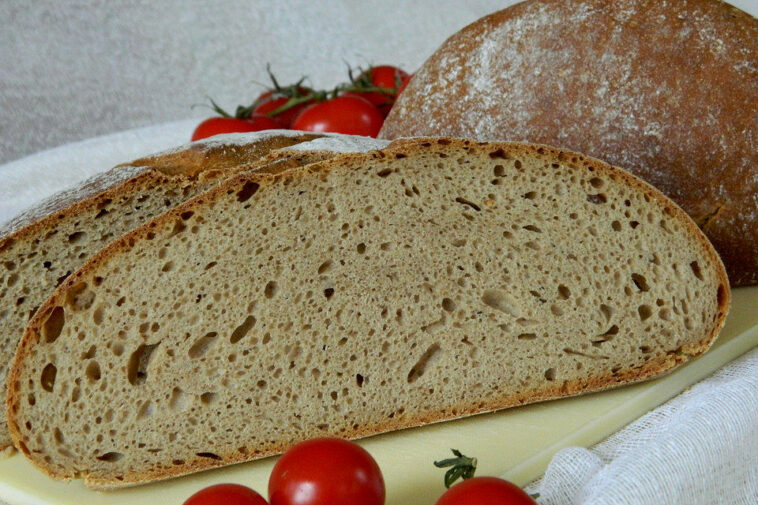
Ingredients for 2 servings:
- 150 g rye sourdough made from 75 g rye flour and 75 ml water
- 300 g rye flour
- 300 ml water
- 100 g wholemeal spelt flour
- 200 g rye flour
- 300 g wheat flour, coarse or coarser, possibly wholemeal
- 100 g yogurt
- 23 g salt
- e.g. bread spice mix (fennel, anise, caraway)
- e.g. water, depending on the type of flour
- Flour for the work surface
Instructions
Working time approx. 40 minutes; Rest time approx. 16 hours; Cooking/baking time approx. 1 hour; Total time approx. 17 hours 40 minutes
The pre-dough, or making the sourdough, takes about 12 hours. To do this, mix an existing sourdough with rye flour and water, then cover with a cloth and let it stand at room temperature. You should therefore plan when the bread will be baked/processed further: 12 hours for the pre-dough, 2 hours for the main dough, 1-2 hours for proving, 1 hour for baking. A little slower is usually not a problem. After the resting time, mix the dough with the other flours (spelt, rye, wheat), yogurt, salt, and spices, and let it rise for 1-2 hours. If you have a very young sourdough and are worried, you can let it stand a little longer or add a little yeast. The advantage: the bread rises better; the disadvantage: it crumbles. The dough should be moist, there should be no flour left in the bowl, but it shouldn’t be too sticky. You always have to adjust the amount of water depending on the flour. I always play around with rye flour and water until the consistency is just right. After the rising time, remove the dough and knead it. A little tip for working with the dough: I wet my hands before removing it. This prevents the dough from sticking, but rather slides. I place it on a lightly floured surface and knead it until the surface is smooth. While kneading, I wipe my hands dry and lightly flour the top of the dough. You have to be careful not to use too much flour, otherwise you’ll end up with little lumps of flour in the bread later. Lightly flour the bread, smooth side up, and place it on a baking pan. If you like, you can score the bread. If you don’t, you’ll end up with a “wild” crust like the one in the picture. If you flour the top, you’ll get that white flour dusting on the bread. Then let the bread rise for 1 hour; don’t be surprised if it doesn’t puff up enormously. In the meantime, fill a roasting pan 1-2 cm high with water and place it at the bottom of the oven. Preheat the oven to 250°C (top/bottom heat); it needs to be really hot. Quickly place the bread in the pan so that as little heat and moisture as possible escapes. Bake at 250°C for about 5-10 minutes, then increase the heat to 190°C and bake for 10 minutes, then finish baking at 150-160°C for about 35-40 minutes. The temperature can vary depending on the oven. If you want a harder crust, you’ll need to leave it at 250°C for longer. If you want a softer crust, one minute is enough. When the time is right, remove the bread from the oven, cover it with a cloth, and place it on a wire rack to cool. Placing it on a smooth surface will prevent excess moisture from escaping, and the bread will become greasy or soggy. You’ll get about 1.5 kg of bread, just like from the bakery! I usually divide them into two loaves, one with bread spice and one without, so that everyone gets something to their liking.


Facebook Comments