 John Myers
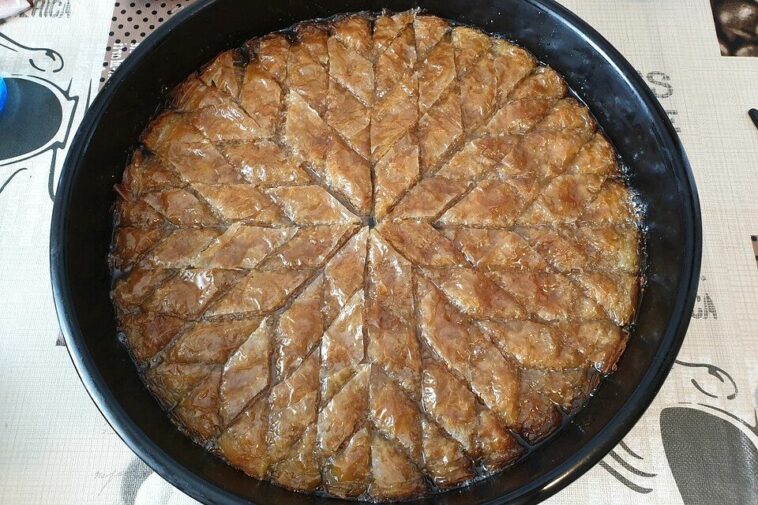
Ingredients for 1 servings:
- 6 eggs
- 6 tbsp sugar
- 6 tbsp yogurt, 3.5%
- 1 pinch of salt
- 5 tbsp oil (sunflower oil)
- n. B. Flour
- n. B. cornstarch
- 500 g margarine (more if needed)
- 1 ½ liters of water
- 1 kg sugar
- 1 half lemon(s), the juice
- 150 g walnuts, finely chopped
Instructions
Working time approx. 2 hours; Total time approx. 2 hours
Original recipe from Kosovo
This is an original recipe from Kosovo. Here the dough is made by hand, which is very time-consuming; you can also use the thin yufka dough bought from an Arab shop. However, if you are a baklava lover, you should try it at least once. Homemade, it tastes simply incomparable. Mix the eggs, sugar, 1-1/2 teaspoons of cornstarch, yogurt, and a pinch of salt with a wooden spoon. Add a little flour at a time and stir again until the mixture is smooth again. Repeat this process until a smooth dough has formed that is easier to handle. Turn the dough out onto a floured work surface and knead with flour until the dough is nice and smooth and no longer sticky. Shape the dough into about 50-70 (depending on the amount of dough) small balls and place them on an oiled baking sheet. Cover with a damp cloth to prevent them from drying out. Now the hard part begins. It’s best to get help with this, as it goes faster. Use a long wooden skewer to roll out the balls into very thin flatbreads until they are slightly translucent. To do this, roll one ball in cornstarch and then roll it out into a round using the wooden skewer. Roll back and forth, turning the flatbread slightly and repeating this process, always working in the cornstarch (not the flour). Place the flatbreads on kitchen towels to dry. Once dry, they can be stacked on top of each other. Repeat this process with the other balls. Brush a deep baking sheet or a large springform pan with oil. Melt the margarine. Spread about 3 layers of flatbreads on the base, or more if you want to cover the base well; the flatbreads can be torn apart if you like. Brush with a little melted margarine and sprinkle with a little sugar. Repeat this process 3-4 times. When the pan is 1/3 coated, sprinkle with half the walnuts. Then make further layers and sprinkle with the remaining walnuts when 2/3 full. Then complete all the layers. If the baklava is too high, simply press it down a little. Brush with margarine. Now cut diamond shapes into the baklava with a sharp knife. Preheat the oven to 250°C. Pour a little margarine into the cut surfaces of the baklava. Then place it on the middle rack of the oven. Check after 10 minutes and let it dry, then brush with margarine. Reduce the oven temperature to about 120°C and bake for 3-4 hours, checking frequently with a fork. If it is too dry, sprinkle with margarine. When it starts to brown on top, place a piece of aluminum foil on top. About half an hour before the end of baking, bring 1.5 liters of water and 1 kg of sugar to a boil with the lemon juice. Simmer until a thin syrup has formed. Immediately soak the hot, finished baklava in the syrup. Work slowly so the pastry absorbs the syrup evenly. We want to avoid it all pooling at the bottom. There shouldn’t be any dry spots, so spread it evenly. Check frequently with a fork. Sprinkle with a few chopped walnuts. Let cool. It tastes best about 2 days after preparation. Keep refrigerated until ready to serve.


Facebook Comments