 John Myers
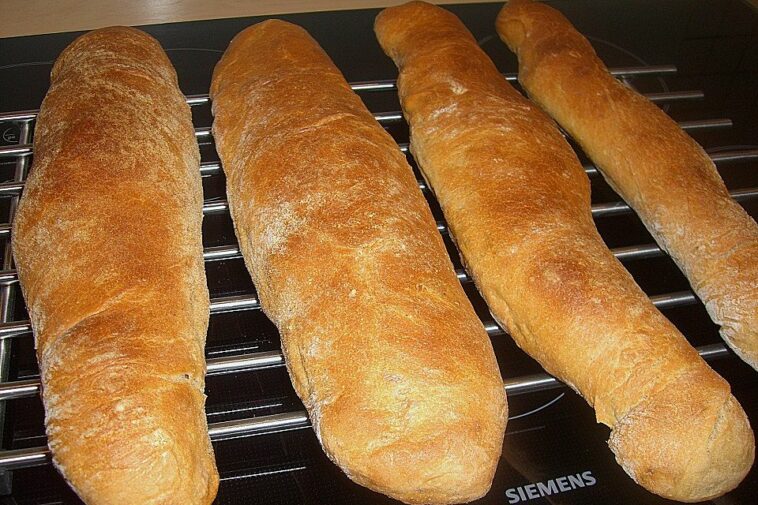
Ingredients for 4 servings:
- 8 tsp whole wheat flour
- 8 tsp wheat flour (type 1050)
- 16 tsp water
- 2 pinches of sugar
- 100 g dough (Lievito Madre)
- 100 g wheat flour (durum wheat flour, fine – semolina di grano duro)
- 50 g water
- a little olive oil
- 150 g wheat flour (type 1050)
- 125 g water
- 2 g yeast
- 250 g dough (biga)
- 275 g dough (pre-dough)
- 200 g wheat flour (type 550)
- 175 g wheat flour (type 00)
- 300 g water
- 1 tsp baking malt or malt coffee
- 20 g salt
- 3 tbsp olive oil
- Flour for the work surface
- Oil for the bowl
Instructions
Working time approx. 1 hour; Rest time approx. 1 day 1 hour; Total time approx. 1 day 2 hours
Large-pored and crispy, but takes time and is not easy!
You only need to make Lievito Madre once, and then you can expand it, similar to sourdough. To do this, mix 1 teaspoon of wholemeal flour and 1 teaspoon of wheat flour type 1050 with 2 teaspoons of water and 1 pinch of sugar, then cover and let stand for 3-5 days. The cover should be breathable (e.g., with a paper towel). Stir once every 12 hours. When a slight fermentation smell develops and bubbles form, stir in another 1 teaspoon of wholemeal flour, 1 teaspoon of wheat flour type 1050, 2 teaspoons of water and 1 pinch of sugar and let stand for about 12 hours. Then stir well and stir in 2 teaspoons of wholemeal flour, 2 teaspoons of wheat flour type 1050 and 4 teaspoons of water (no more sugar!). Let stand for 12 hours. Stir in 4 teaspoons of wholemeal flour, 4 teaspoons of wheat flour type 1050 and 8 teaspoons of water. Let stand for 12 hours. This is the basic amount. You can feed it more (double the amount, let it stand for 12 hours) if you need more, or store it in the refrigerator. When you remove the Levito Madre, refill it with the same amount of flour and water. It’s best stored in a screw-top jar in the refrigerator. The above steps are then skipped. You only need to do this the first time. For the biga, lightly knead all the ingredients and lightly oil the meatball with your hands. Let the dough stand in a covered bowl for about 12-18 hours at 20-22°C. It will expand and increase in volume. Durum wheat flour is more like durum wheat flour, and is finer than durum wheat semolina. For the starter, mix all the ingredients well and let it stand in a covered bowl for about 16 hours at 15-18°C. It will increase in volume and become bubbly. For the main dough, mix the flour and water and let it stand for about 30 minutes to allow the flour to swell. Then add the biga and pre-dough and knead for 10 minutes using a mixer. Then add the salt, malt, and oil and knead for another 2 minutes, until everything is incorporated. Let it rest for a few minutes. Tip the dough onto a lightly floured work surface. Now it’s time to work the dough: Following Richard Bertinet’s method, the initially very soft dough is lifted under the side facing away from the body and slapped firmly onto the work surface with the lower (nearest) back. The upper part, which you are holding in your hands, is folded over it. Then the package is lifted at an offset of 90°C and the process is repeated. Bertinet does this 600 times. This incorporates air, the dough gains more and more stability, loses its stickiness, and becomes taut. I didn’t knead it that long, though; I stopped after about 100 kneadings. In the beginning, you often have to scrape the dough from the work surface with a dough scraper. The dough is then placed in a large, lightly oiled bowl or a wide plastic container, covered, and left to rise for approximately 2-3 hours. Every 20 minutes, slide it onto the countertop and stretch/fold it: Pull the end closest to your body and fold it 1/3 onto the dough. Pull the end farther away and place it on top. Pull the left side away and fold it 1/3 onto the dough. Pull the right side away and place it on top. Return the dough to the bowl with the top side down. The dough will become tighter and puffier each time. Be careful not to break the large bubbles that form! After the rising time, slide it onto the countertop, carefully pull them apart a little, and divide them into four pieces using a dough scraper. Stretch these pieces slightly into shape and gently fold the long sides of each piece over each other without breaking the bubbles. Pinch the seam together firmly. Place it in the couche with the end (the “seam”) facing up. A couche is a floured cloth (preferably linen) that is pulled up between the long pieces of dough. Cover and let rise for another 60 minutes. Now preheat the oven with a baking stone to 300°C. After the rising time, add the loaves and steam them thoroughly for 10 minutes (best with a pressure sprayer that inflates and then releases a wide, strong jet). Then reduce the temperature to 240°C, and after another 10 minutes (approximately) to 200°C. After 25-30 minutes, they are done. Turn off the oven. You can then leave them in the oven for another 10 minutes with the door open (for a crispy crust). I took the basic idea for this recipe (with biga and pre-dough) from LarissaL. I modified the flour used and also added the Bertinet method of slapping the dough. I also adjusted the baking temperature to my baking stone. Thank you, Lara!



Facebook Comments