 John Myers
Contents
show
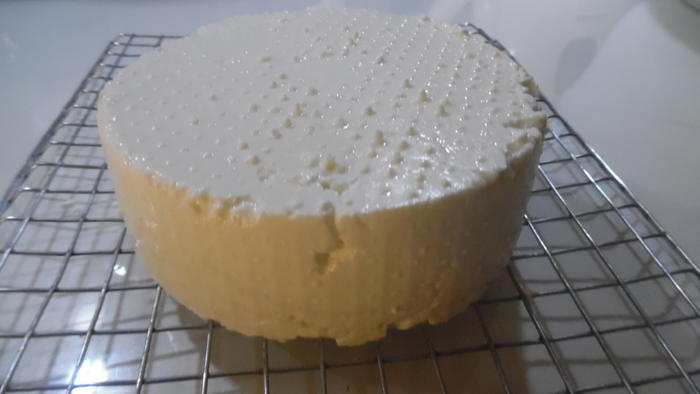
Make Feta Cheese Yourself
The perfect make feta cheese yourself recipe with a picture and simple step-by-step instructions.
Sheep:
- 260 g Sheep’S Milk Powder (Internet)
- 3 l Lukewarm water
Cow:
- 3 l Whole milk with at least 3.5% fat
- 0,25 tsp Me culture (explanation see below)
- 25 drops Calcium chloride solution 35% (explanation see below)
- 25 drops Vegetarian rennet
Working tools:
- 1 Pot with lid, capacity approx. 5 l
- 1 Thermometer for liquids
- 1 Long cake knife or cheese curd cutter
- 1 Ladle
- 1 Drip pan with press lid or alternatively a kitchen sieve and a boiled linen cloth
- 1 Larger glass filled with water to weigh down
- 1 Grid underlay if a press mold is used
- 1 Bowl underneath to catch the whey
- Possibly disposable gloves
- 1 Hot cleaned wooden trowel
Explanations see above:
- “ME cultures” are so-called acid starters (starter cultures from lactic acid bacteria). You can also use diluted citric acid (available in the SB in powder form for preserving), but the dosage is difficult. The first batch of cheese curdled for me immediately and I had to dispose of everything. “Calcium chloride solution” improves the gel strength and the rennet effect.
- After previous unsuccessful attempts with other ingredients, I have now found the “right” ingredients on the Internet and can only recommend them to anyone who is interested (I will give the address in PN).
- You don’t necessarily have to have a cheese drip pan. A normal kitchen sieve and a boiled, white linen cloth do the same. It is only important that all devices are really extremely clean, as bacteria can develop quickly. Also wash your hands with soap from time to time or put on gloves.
- Since I would like to make different types of cheese myself in the future, I bought the so-called “starter package”, and it came with an 800 g mold. The one-time purchase is not expensive. For the rennet, you could choose between animal and vegetarian rennet. I chose the vegetarian one.
To milk:
- Here it should be said in advance: Do not use ESL or long-life milk, but normal whole (fresh) milk. 3.5% at least, 3.8% even better. Not to be confused with raw milk (for everyone who can buy it directly from the farmer). This is because it should be heated (i.e. pasteurized) to at least 75 ° for approx. 30 – 40 seconds before it is used in order to kill pathogenic germs. Then it has to cool down to 25 ° and then it goes on, as with the pasteurized milk. It is best to use milk powder for sheep feta, as it is easier to obtain (Internet) and also more durable. The required amount per liter can be found in the manufacturer’s package.
Production of sheep and cow feta:
- First dissolve the sheep milk powder thoroughly in 3 l of lukewarm water using a hand mixer.
- Then put the cold sheep or cow milk in a 5 l saucepan and slowly heat it to 25 °. Use a thermometer.
- In the meantime, put 25 drops (1 teaspoon was 1 teaspoon) of calcium chloride solution in a cup and add 10 teaspoons of cold water (mix always 1:10). Mix well. Do the same with the 25 drops of rennet and have both ready.
- Once it has reached 25 °, first stir in the powder of the ME culture thoroughly (alternatively the citric acid) and then the diluted calcium chloride solution.
- Heat the milk further up to 37 °. When they are reached, stir in the diluted rennet thoroughly. If a “vortex” has formed while stirring, “stop” it with the wooden trowel and the milk calms down. Put a lid on the pot and then slide it off the stove. From now on, do not move or shake it so that the jelly (solid milk) does not crack. The result must be a beautiful, uniformly smooth mass that at first glance looks like a pudding without a skin. Rest time after adding rennet for at least 30 – 40 minutes.
- When the time has elapsed, hold the pot at a slight angle. When the mixture comes off the wall of the pot like a pudding, it is ready to be cut. This is done with a very long knife (at least as long as the pot is deep) or with a cutter. In fact, I only had one angle pallet to use when baking. The mass is cut at a distance of 0.5 – 1 cm deep down to the bottom of the pot, lengthways and crossways, so that cubes are visible at the top, but small pillars are created towards the bottom. This is left to rest for 15 minutes. The whey begins to settle.
- Now you run the ladle carefully and carefully through the cut jelly mixture, so that the “pillars” become small fragments the size of a hazelnut. This is then left to rest for another 90 minutes.
- In the meantime, you can put the drainer on a bowl covered with a grid or put a kitchen sieve with a boiling hot linen cloth (should be big enough that you can beat it over the mass afterwards) and put it in a Hanging bowl.
- After the 90 minutes have elapsed, the curd is skimmed off and filled into the prepared container. In the case of the form, you put the corresponding lid on the mass and put a larger, water-filled screw jar (preferably a cucumber jar) on it to weigh it down. With the sieve, you knock the edges of the cloth over the mass and place the glass on it.
- After 20 minutes you have to turn the mass for the first time. This is a bit complicated the first time, because the mass is still quite wobbly. But it works. Then turn again after 20 minutes. It’s getting better. It must be turned a total of 4 times – always at an interval of 20 minutes. After turning it 4 times, weigh it down again and let it drain properly. This takes at least 6 hours, but can be extended depending on the desired firmness of the cheese.
- Then you take the cheese out of the mold and store it in a well-sealable container in the refrigerator. If he loses some whey in the process, that’s normal. This is then poured off and can either be used pure the next day or seasoned with a little salt and herbs.
- Those who like do not have to dispose of the whey that has been collected and retained, but are welcome to drink it.
- It sounds or looks like a lot of work. But it isn’t, because you have a lot of rest. But it is a job that is worthwhile because the taste is terrific.
- From the 3 liters of milk I received a cheese weighing 400 g. The above quantity refers to this one portion.


Facebook Comments