 John Myers
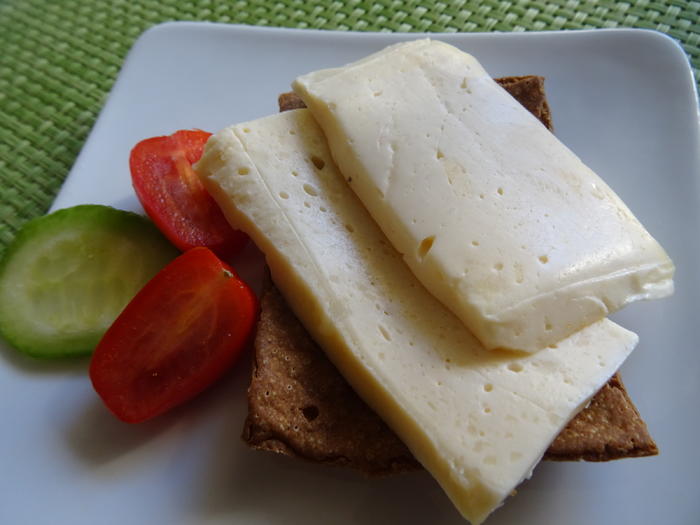
Semi-hard Cheese
The perfect semi-hard cheese recipe with a picture and simple step-by-step instructions.
- 1000 g Layered cheese three-quarter fat
- 150 g Butter
- 1,5 tsp Salt
- 1 tsp easy go. Sodium bicarbonate (baking soda)
- 1 Egg
- Bring 2 liters of water to the boil in a larger saucepan. Crumble in the layered cheese, stir with a whisk, turn the heat down halfway and simmer for 20 minutes until the cheese is crumbly. Meanwhile, put a colander on a large bowl (capacity approx. 4 l) and line it with a fine-meshed linen cloth. Also let the butter melt in a medium-sized saucepan over a very low heat, take it off the stove and keep it ready.
- When the cooking time is over, pour the contents of the pot into the lined colander and drain the remaining white cheese crumbs well. When they are no longer too hot, squeeze them out a little more with the help of the cloth, enough so that they then crumble and fall apart. Then put the cheese crumbs in the melted butter. Add salt, baking soda and egg and puree everything with the hand blender. That turns into a small show of strength, because it takes a while to get everything smooth. With increasing suppleness, the mass becomes more and more viscous, making it more difficult to circle with the stick. But it is quite doable and the cheese will be nice and smooth later.
- Then immediately fill the finished mass into any shape (for more information on this at the end of the recipe), press it in gently and smooth the surface. Then put the mold in the refrigerator for at least 4 hours. It is ideal overnight.
- No additional rennet (an enzyme from the abomasum of young cows) was used for coagulation with this cheese. Only the portion that is in the layer cheese is included. The baking soda ensures looseness and is completely harmless to health. It is a smooth, semi-hard (hard) cheese that tastes great as a cold cut, but is also suitable for refining or gratinating dishes. You can also add herbs, bacon, nuts or spices to the mixture after mixing, if you wish.
- The amount of ingredients mentioned above resulted in a serving of 525 g cheese. Subsequent storage in the refrigerator. The storage time is slightly shorter than that of the purchased cheese, as it does not contain any shelf-life substances.
Explanation of the forms:
- They can be round, rectangular or square, made of ceramic, plastic or aluminum. There are no limits to your imagination. But you should estimate how big it has to be based on the quantity. Please determine that yourself. I have reusable aluminum box molds (originally purchased for the production of Leberkäse), which are very suitable for this. The forms – regardless of the type – do not have to be lined or greased.



Facebook Comments