 John Myers
Ingredients for 1 servings:
- 200 g flour per person (Italian Tipo 00 or German 405)
- 2 g yeast, fresh, per 100 g flour
- 1 can tomato(s) (Pizza tomatoes)
- 1 can of tomato paste
Instructions
Working time approx. 30 minutes; Rest time approx. 3 hours; Total time approx. 3 hours 30 minutes
Pizza dough to the exact gram
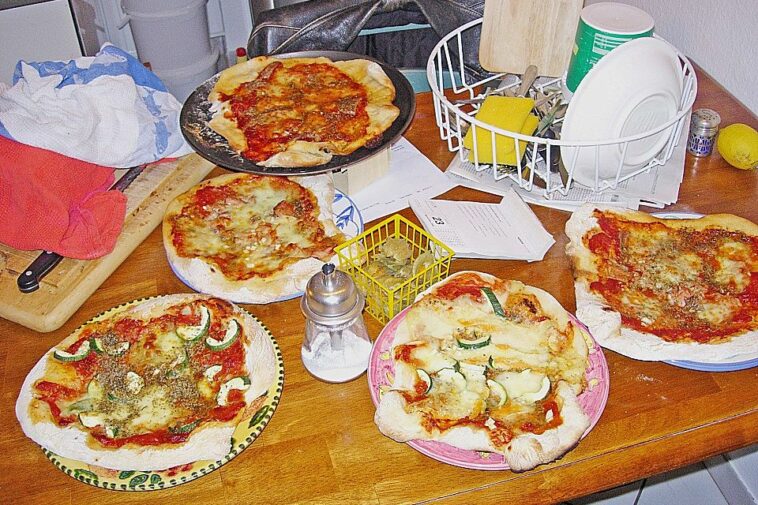
For years and years, I made pizzas with very different results, the idea being, of course, to create a pizza in the Italian style. For us, this means a thin yet sturdy base and a crispy crust. Bubbles in the dough during baking are very welcome. To get good, reproducible results, I’ve switched to using a scale to weigh the flour and yeast to the exact gram. Since this is the only recipe where I don’t mix by eye or by container size, I call it the academic pizza dough. What does it look like? Put 200g of flour per person into a bowl – as white as possible, 405 or better, type 00 from Bella Italia; all attempts with coarser flour resulted in rubbery doughs that couldn’t be rolled out because they kept shrinking. For every 100g of flour, I add 2g of cubed yeast (rubbed between the palms of my hands). Then comes the messy part, because I never measure the amount of water. Salted cold water is added to a 1-liter beaker and added to the bowl in moderate amounts. Stir with a mixer and a whisk, adding only a little water at a time; it should never start to “squish”; it’s good if the intermediate stage is crumbly. Eventually, it will form into a smooth dough that you can manipulate in the bowl with the whisk like Hendrix with his guitar. The result is a dough that doesn’t stick to the whisk or the bowl. If it does stick, it needs to be floured. Then place a cloth over the bowl and put it in the refrigerator! Depending on our daily schedule, it stays there for between three and six hours. The rest is pretty straightforward: knead thoroughly with your hands on a floured surface, divide into portions, and roll out. Roll out rather thinly here, too, and trust the dough to hold its own. For the tomato base, I’ve found a good way to use a can of pizza tomatoes mixed with a can of tomato paste. Top with as desired. The tomato base is applied quite thinly, and the topping shouldn’t release much liquid (e.g., squeeze spinach) so the pizza doesn’t “sag.” The pizza needs as much heat as possible; if you can manage more than 350 degrees, you should start at 350 degrees. Best results are achieved on oven rack level 3, but you can bake on racks 2 and 3 and swap them halfway through. Pizza pans with small holes help the crust cook through and thus become stable; with large holes, the dough tends to get stuck in the holes. If you have more pizza to bake than will fit in the oven at once, you can roll it out and place it on the pan. Then put it back in the fridge, because the end of a nice thin crust is when it starts to rise at room temperature.



Facebook Comments